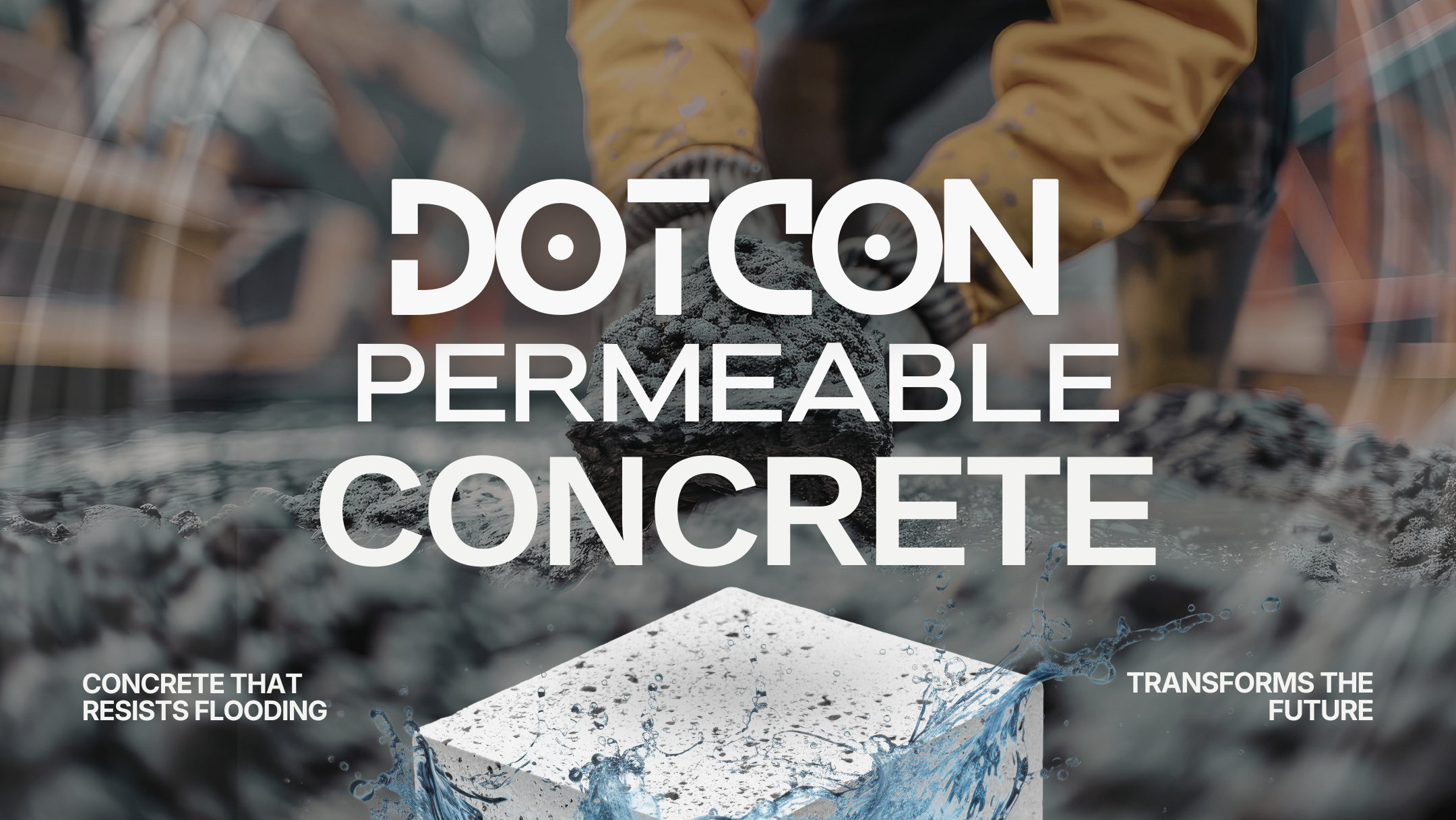
In recent years, Japan has seen a growing severity of urban flooding due to heavy rainfall and the urban heat island effect. PUMPMAN Co., Ltd. (based in Akiruno City, Tokyo) has developed a next-generation permeable concrete called Dotcon, designed to help mitigate flood damage and reduce environmental impact. While maintaining the strength of conventional concrete, Dotcon features a structure that avoids "sealing" the ground, allowing rainwater to return to the earth naturally.
Dotcon incorporates 18 patented φ65mm sleeves into each 90cm x 90cm panel, enabling rainwater to penetrate directly through “point infiltration.” Dotacon’s technology is the world’s first system to enable level-surface installation. It has been shown to reduce surface temperatures by an average of 1.2°C during the day and 2.4°C at night—making it an effective solution for combating the urban heat island effect.
Where traditional paving materials focused on "eliminating" rainwater, Dotcon takes the opposite approach: making use of rainwater. The innovative concept is rooted in the development team's belief in “learning from nature,” and the material itself represents a true fusion of technology and sustainability.
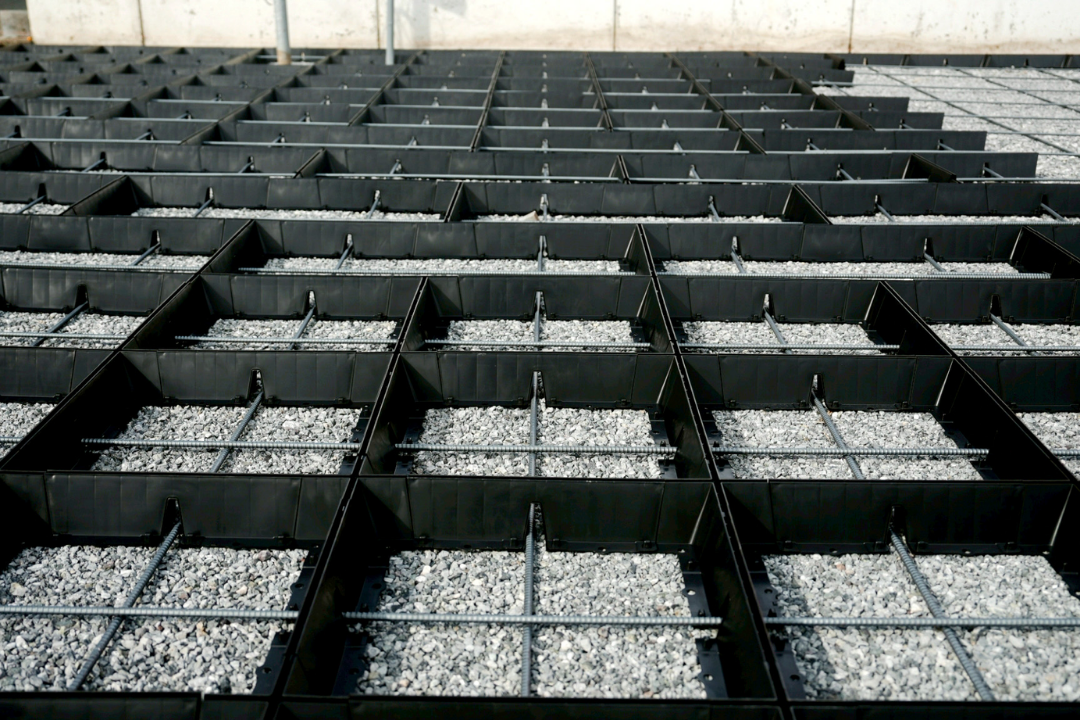
Installation follows the same process as standard concrete pouring and requires no special equipment. A sheet made from recycled polypropylene (using repurposed plastic) is laid down, and the concrete is poured directly on top—an easy and efficient method that has contributed to Dotcon’s growing popularity.
Dotcon Overview
Dotcon, based in Akiruno City, Tokyo, is an innovative permeable concrete system designed to create cities that coexist with rainwater. By integrating patented sleeves into its concrete panels, Dotcon enables pavement that doesn’t “seal” the ground, allowing rainwater to seep back into the earth efficiently. It is a technology that helps reduce the risk of urban flooding and addresses key challenges faced by modern cities, such as the heat island effect and groundwater conservation.
No special equipment is required for installation, making the system easy to handle for anyone. With environmentally conscious design that incorporates recycled polypropylene formwork made from waste plastic, Dotcon combines strength, aesthetics, and water permeability. Recognized as a next-generation infrastructure material, it has earned high praise from municipalities, architectural firms, and construction companies both in Japan and abroad.
Dotcon’s mission is to support the future of society and the planet—starting from the ground beneath our feet.
Dotcon’s Permeable Water-Retaining Concrete
Dotcon products are multifunctional concrete paving materials that offer outstanding permeability, water storage capacity, and environmental performance.
One of their key features is high permeability. Rainwater passes smoothly through evenly spaced openings and infiltrates directly into the ground. With a permeability rate of nearly 100 percent (permeability coefficient: 0.9), Dotcon efficiently returns rainwater to the soil.
Another important feature is the panel’s internal void structure, which allows water to be stored while it permeates. This primary retention function helps reduce peak runoff during heavy rainfall, thereby lowering the risk of urban flooding. Dotcon ver.2 can store approximately 14 liters per panel, while the square Dotcon+ type (1 square meter) can store about 13 liters.
From an environmental standpoint, Dotcon is also effective in mitigating the heat island effect. Compared with conventional concrete pavement, it maintains a lower surface temperature, with an average reduction of approximately 1.2°C and a nighttime average reduction of about 2.4°C.
Dotcon also excels in constructability. Its high permeability eliminates the need for drainage slopes, allowing for level installation. This increases design flexibility and helps simplify construction.
In addition, the absence of drainage slopes and drainage facilities, combined with reduced concrete use and the potential for subsidies, makes overall cost reduction possible. Dotcon+ further enhances cost efficiency by eliminating the need for formwork and reinforcing steel.
Maintenance has also been carefully considered. Permeability performance can be restored by loosening the base layer through the joints using aeration or vacuum equipment. With regular maintenance, high-permeability performance can be sustained over the long term.
Because of these features, Dotcon can be widely utilized by municipalities promoting urban stormwater management and environmentally conscious infrastructure development, as well as by professionals in fields such as civil engineering, construction companies, design firms, and landscape designers. It is also a suitable paving material for sites that require both reduced environmental impact and functionality, including commercial facilities, public buildings, station plazas, pedestrian spaces, parking areas, and residential developments.
“Water Is Not the Enemy” A Personal Insight and a Call to Rethink Urban Planning
Source: Dotcon Homepage
At the heart of Dotcon’s development lies a challenge that PUMPMAN’s president and engineering team have faced for years: urban flooding. As cities have become increasingly urbanized, concrete and asphalt have covered the ground, preventing rainwater from soaking into the earth and instead contributing to floods. Urban flooding is a chronic issue shared by many cities and has been a core theme for PUMPMAN since its founding.
It was from the ongoing struggle that a radical question emerged: “Instead of eliminating water, can we create infrastructure that coexists with it?” With a shift in thinking, the engineering team embarked on hundreds of prototypes and field tests to develop a technology that could achieve both permeability and strength. Through a long process, they invented the patented φ65mm sleeve, which is now the core component of the Dotcon system.
Dotcon is more than just a material—it embodies a philosophy aimed at reshaping how we think about cities. Instead of drainage, it promotes restoration. Instead of blocking water, it encourages circulation. It is a mindset that aligns closely with today’s global movements, including the SDGs, carbon neutrality, and decarbonization. The development team sees its mission as bringing back “breathing ground” to urban spaces, pushing beyond conventional paving to reimagine urban infrastructure.
Dotcon is no longer viewed as “just another construction material,” but rather as a foundation that embodies a societal vision. As its adoption grows, so too does the concept of a “society that lives in harmony with water,” spreading across Japan—and increasingly, the world.
Project Examples and Use Cases
Between 2024 and 2025, PUMPMAN has carried out multiple Dotcon installations across Japan, including in Ishikawa, Saitama, and Hokkaido, deploying the technology in parking lots and on sidewalks. In urban areas, in particular, Dotcon has proven effective in reducing the burden on drainage systems by ensuring that water percolates into the ground even during short bursts of heavy rainfall. In sidewalk applications, many users have commented on its slip resistance and ease of walking, even in wet conditions.
By the summer of 2025, Dotcon had also entered the residential and landscaping sectors in Tokyo neighborhoods. Under the new concept of “Dotcon x Gardening,” the material is gaining attention not only as a civil engineering solution but also as a design option for exterior spaces. Thanks to its combination of permeability and visual appeal, Dotcon is being used for private garden paving, pathways in public parks, and shared spaces in apartment complexes.
For example, in Obihiro City, Dotcon was installed in a pedestrian area near a bus terminal and received praise for its slip resistance even in icy winter conditions. Its surface structure provides just the right amount of friction while efficiently returning water to the ground, helping to reduce the risk of freezing. This has made Dotcon a highly effective solution for cold regions, with potential for broader adoption in similar areas.
In addition, Dotcon is being incorporated into eco-town development projects and urban revitalization efforts led by local governments, becoming part of the “regional brand” in many areas. Its ability to blend with local landscapes and culture while also serving as a cutting-edge infrastructure solution makes it attractive to a wide range of communities. In areas where Dotcon has been installed, residents have reported benefits such as “no puddles even when it rains” and “cooler ground temperatures in the summer,” reflecting its role not just as paving, but as a material that enhances overall quality of life.
These growing achievements are drawing attention not only from government agencies and architectural firms but also from general contractors and private companies focused on environmentally conscious construction. Looking ahead, Dotcon is expected to expand into educational facilities, healthcare centers, tourist sites, and beyond.
Major Municipal and Facility Installations
- Tokyo: Shinjuku Ward, Akiruno City (model project)
- Ishikawa Prefecture: Kanazawa City (park facilities)
- Saitama Prefecture: Kawagoe City (station area redevelopment)
- Hokkaido: Obihiro City (bus terminal)
- Switzerland: Urban redevelopment project (scheduled for 2025)
In municipalities where Dotcon has been implemented, it has received high praise from both residents and tourists. Many have commented on how well it drains, even on rainy days, and how easy it is to walk on. Its strong alignment with local governments’ decarbonized urban development strategies suggests that adoption is likely to continue expanding in the future.
Design and Social Value: Awards and the SDGs Perspective

Source: Dotcon Homepage
Dotcon has received the Good Design Award for two consecutive years in 2023 and 2024, and was also selected for “Summer of Design 2025” in Tokyo’s Marunouchi district. The product continues to earn high praise as a solution that connects environmental sustainability with the future of urban living.
Their recognition stems not only from its visual appeal but also from its strong public value. Dotcon enables aesthetically harmonious landscape design while creating safe, comfortable pedestrian spaces accessible to everyone. Their innovative approach directly aligns with the SDGs goal of building sustainable cities and communities.
Additionally, testing by the Rainwater Storage and Infiltration Technology Association has confirmed that Dotcon offers water permeability performance equivalent to that of standard infiltration pits. As a result, its reliability is well established. It is increasingly valued as a material that provides the kind of “invisible functionality” essential to modern urban infrastructure.
Dotcon’s Benefits and Impact
The following benefits can be expected from the implementation of Dotcon:
- Returning rainwater to the ground → Reduces the risk of urban flooding
- Replenishing groundwater → Supports a sustainable water cycle
- Lowering ground temperatures → Helps mitigate the heat island effect
- Use of recycled materials → Contributes to SDG implementation
Especially in urban areas, where asphalt-covered surfaces continue to increase, permeable pavement like Dotcon is gaining attention for its role in “dialogue with the earth.” Its ability to help the planet “breathe” is seen not merely as a technological innovation, but as a symbol of both responsibility and hope for the future.
In addition, Dotcon prioritizes both aesthetics and safety, offering a pedestrian-friendly surface that is gentle on older people, children, and all who walk on it. As a material that supports both the environment and daily life, Dotcon plays a key role in reimagining the future of urban spaces.
Pricing and Installation Rates
The price of Dotcon ranges from approximately 6,000 to 9,000 yen per panel (excluding tax and installation fees), making it competitively priced compared to traditional interlocking blocks or asphalt paving. It stands out for its strong long-term cost performance, particularly in terms of balancing initial investment with ongoing maintenance costs.
Dotcon uses a reusable formwork system, which significantly reduces labor on-site. It improves work efficiency, shortens construction time, and helps lower labor costs. Since no specialized machinery is required, the system is easy to adopt even for small- and mid-sized contractors across Japan, thereby lowering barriers to implementation.
In many cases, Dotcon projects qualify for government or municipal subsidies to promote environmentally friendly paving solutions. There are growing examples of municipalities working in partnership with Dotcon to reduce costs. For instance, in Kawagoe City, Saitama Prefecture, Dotcon was used to redevelop the area around the train station. By leveraging a local urban development grant, the city reduced total construction costs by about 20%.
Furthermore, the use of eco-friendly materials, such as polypropylene components made from recycled plastic, is often viewed favorably in subsidy evaluations. Making Dotcon a compelling proposal for general contractors and architectural firms, serving as a powerful asset when bidding on public or environmentally focused projects.
As a result, Dotcon is increasingly recognized not just as a paving material but as a solution that offers both cost-effectiveness and social value.
Looking ahead, efforts to expand mass production and streamline logistics are expected to optimize pricing further. As exports to regions like the Middle East and Europe scale up, Dotcon could leverage economies of scale to reduce costs and accelerate adoption across a broader range of areas and applications.
Comparing Alternative Materials
Dotcon demonstrates significant advantages over conventional paving materials across multiple aspects. For example, interlocking pavers offer some degree of permeability through surface gaps. Still, they present long-term maintenance issues such as weed growth and dirt accumulation between joints, making it challenging to preserve their appearance over time.
Asphalt paving, on the other hand, is quick to install and cost-effective, but it lacks permeability. Rainwater simply flows into drainage systems rather than being absorbed into the ground, often contributing to urban flooding and the heat island effect.
Dotcon addresses these challenges with its patented φ65mm sleeve system, which enables “point infiltration” of rainwater. The structure provides exceptionally high permeability while also allowing flat, barrier-free installation with strong visual appeal. The Dotcon Plus version offers load-bearing capacity exceeding 10 tons, making it suitable for commercial facilities and public spaces.
In addition, Dotcon uses recycled plastic materials, reducing both environmental and economic impact through simplified construction. It transforms paving from a surface that merely repels water into one that connects with water—redefining it as a device for interacting with the urban environment.
Dotcon is an innovative material with the potential to reshape urban planning itself. Rather than treating paving as just a base layer, it proposes a new-generation alternative: a medium for dialogue between people and the city. With their philosophy, Dotcon is poised to become a leading choice for the future.
Dotcon’s Future Vision: Embracing Diversity and Sustainable Cities

Source: Dotcon Homepage
Dotcon is more than just a paving material—it embodies the concept of environmental coexistence in urban spaces. Its permeable structure allows it to prevent flooding while maintaining visual appeal, functioning as a low-impact, sustainable piece of urban infrastructure.
A key strength of Dotcon lies in its nationwide construction network, which enables easy adoption by local governments and small contractors alike. The accessibility helps break down barriers such as urban-rural gaps and high initial costs, paving the way for a society where environmentally conscious paving is an option for everyone.
The upgraded Dotcon Plus model offers increased load-bearing capacity (up to 10 tons), a wider range of design options, and improved maintenance performance—expanding its range of applications even further. Future plans also include features like universal design compatibility and multilingual guidance, making Dotcon a valuable contributor to greater inclusivity in urban environments.
Permeable Innovation Expanding Nationwide and Worldwide
As of July 2025, Dotcon has established construction partners in all 47 prefectures across Japan. Its adoption is expanding to municipalities, commercial facilities, and public spaces, with installations in parking lots, sidewalks, parks, and more. In collaboration with the Tokyo Metropolitan Government, Dotcon has been recognized as a “Rainwater Infiltration Ambassador,” and model projects are now spreading nationwide.
For example, in Akiruno City, Dotcon has been introduced as part of the region’s climate change strategy to serve as a temporary water-retention system during heavy rainfall. These locally rooted success stories are encouraging other municipalities to follow suit, leading to steady, widespread expansion.
In May 2025, Dotcon also achieved its first international shipment, delivering 200 panels to Switzerland for use in an urban planning project. Looking ahead, pilot programs are planned in the Middle East, including Dubai and Saudi Arabia, signaling the acceleration of Dotcon’s global reach. Dotacon’s technology, now drawing international attention, represents a new frontier for Japan’s infrastructure exports.
Conclusion
Dotcon is more than just another building material. It offers a clear answer to how we should shape the cities of the future. In an era of accelerating climate change, increasingly frequent localized downpours, and growing urban density that hardens the earth’s surface, Dotcon challenges us to rethink our approach — not to simply “drain away rainwater,” but to coexist with it.
Behind the development of Dotacon’s product lies the conviction and passion of engineers who have seriously grappled with the future of urban life and the global environment. Beneath its cold, hard surface flows a more profound philosophy — one of dialogue between cities and nature.
Dotcon is now being adopted not only by municipalities across Japan but also in urban development projects overseas. Its value is recognized not just for its functionality, but also for its social and cultural significance. From mitigating the heat island effect to reducing the risk of urban flooding by returning rainwater to the ground and achieving a balance between aesthetics and usability, Dotcon represents a meaningful step toward helping cities breathe again.
Their technology also aligns perfectly with today’s values: sustainability and diversity. With surfaces that are easy for everyone to walk on, visually harmonious landscapes, and a design that is gentle underfoot for all, Dotcon embraces universal design and helps build cities where everyone can live and thrive together.
The cities of the future must be more than just convenient and well-organized—they must coexist with nature and nurture human-centered living. Dotcon is quietly leading a revolution toward that vision of the future.
Just as water gently soaks into the earth, Dotcon will quietly extend its kindness throughout every corner of society. In doing so, it will gradually and steadily transform our daily lives and the future of our planet.
FAQ About Dotcon
1. What Is Dotcon?
Dotcon is a permeable concrete paving material that allows rainwater to seep into the ground. Using a patented sleeve structure, it returns water to the soil, helping reduce urban flooding and mitigate the heat island effect. Unlike conventional paving that repels water, Dotcon is designed to work in harmony with it.
2. How Does It Differ From Traditional Asphalt Or Concrete?
The main difference is permeability. While traditional paving is designed to drain water away, Dotcon allows water to infiltrate into the ground, supporting natural circulation. This can help reduce flood risk and lower surface temperatures.
3. What Are The Actual Benefits Of Using Dotcon?
Measured results show temperature reductions and improved water management. Surface temperatures can decrease by approximately 1.2°C during the day and up to 2.4°C at night, contributing to heat island mitigation.
4. What Is The Installation Cost?
Material costs are typically around 6,000 to 9,000 yen per unit, with installation charged separately. While initial costs may be similar to or slightly higher than standard paving, reduced drainage requirements and lower long-term maintenance costs contribute to strong overall cost performance.
5. Is It Durable?
Yes, durability and strength have been verified through testing. Dotcon Plus, for example, can withstand loads of over 10 tons, making it suitable for applications such as parking lots and commercial facilities. Its ability to combine permeability with strength is a key advantage.
6. Where Is Dotcon Used?
It is being adopted in a wide range of locations, including parking areas, sidewalks, and parks. Its applications are expanding from urban infrastructure to residential settings, with growing attention both in Japan and internationally.
7. Are Subsidies Or Incentives Available?
In some cases, Dotcon qualifies for subsidies as an environmentally friendly paving solution. Depending on the municipality, part of the installation cost may be covered, reducing the overall financial burden. There are documented examples of these supports being utilized.
8. Could Dotcon Become A Mainstream Paving Material?
It has strong potential to become more widely adopted. As climate change and urban flooding challenges intensify, the concept of water-compatible paving is gaining importance in urban design. Dotcon’s ability to address environmental, disaster-prevention, and design needs positions it for broader adoption in the future.
Related Videos
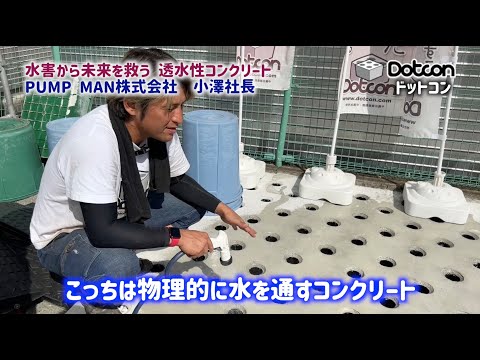
If you're interested in Japan’s approach to sustainable infrastructure, the video below introduces Dotcon, a permeable concrete designed to reduce flooding risks. This video shows how water can pass through the material, helping manage rainwater and improve urban resilience.