
In Japan, soy sauce breweries are often associated with centuries-old fermentation techniques and regional food traditions. Few people would expect one of these breweries to become known for vending machines.
That is exactly what happened with Futanda Shoyu Co., Ltd., a soy sauce producer based on the island of Etajima in Hiroshima Prefecture. While continuing its traditional soy sauce business, the company chose to focus on another cornerstone of Japanese cuisine: dashi, the stock that forms the flavor foundation of countless Japanese dishes.
Its flagship product, Dashi Douraku, is a liquid dashi made with whole grilled flying fish, known in Japan as yaki ago, placed directly inside the bottle. What transformed the product into a national talking point, however, was not just the recipe but the distribution model. Futanda Shoyu introduced dedicated refrigerated vending machines that allow customers to purchase authentic dashi 24 hours a day.
Around the world, interest in home cooking, natural ingredients, and minimally processed foods has been growing. At the same time, traditional cooking methods that require time and specialized knowledge are becoming harder to maintain in everyday life. Japanese dashi culture sits directly at this intersection.
Making dashi from scratch is rewarding, but it requires ingredients, technique, and time. Dashi Douraku attempted to remove those barriers by turning traditional flavor into something as accessible as everyday infrastructure.
This article explores the philosophy behind Futanda Shoyu, why a soy sauce brewery chose vending machines as its primary sales channel, the business implications of that decision, and why this model may have potential far beyond Japan.
Dashi Douraku Overview
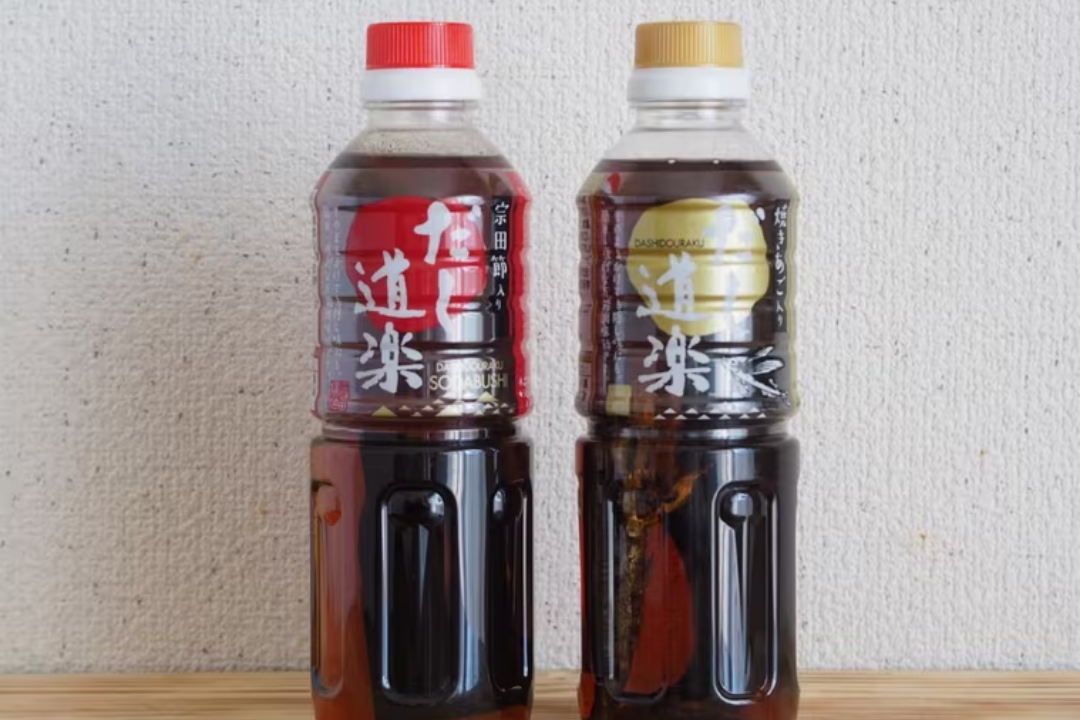
Dashi Douraku is a liquid dashi product manufactured and sold by Futanda Shoyu. Its defining feature is immediately visible: whole grilled flying fish and kombu kelp are placed directly inside the bottle and steeped in a soy sauce-based seasoning liquid.
The goal is simple but ambitious. Rather than asking consumers to prepare authentic stock from scratch, the product allows them to recreate traditional Japanese dashi simply by diluting it with water or hot water.
The resulting stock can be used in a wide variety of dishes, including:
- Udon noodle soup
- Miso soup
- Simmered dishes
- Hot pots
- Japanese-style sauces and broths
The product sits in the premium seasoning category, positioned for everyday use while still aiming to deliver restaurant-quality flavor.
What truly distinguishes Dashi Douraku, however, is its distribution strategy.
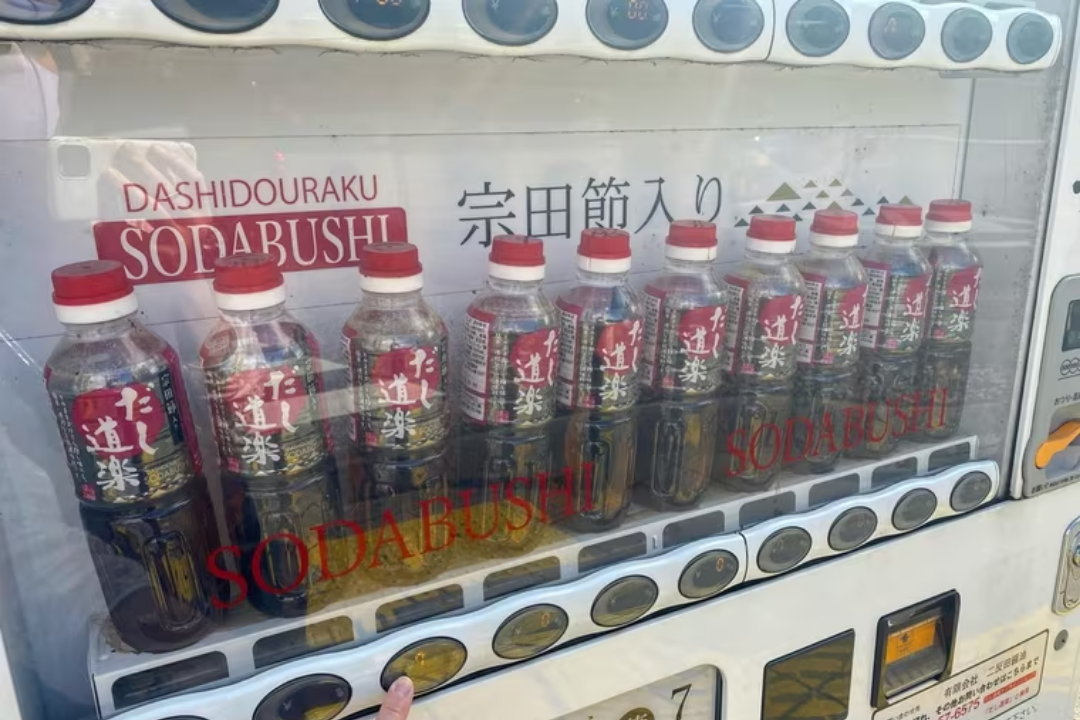
Instead of relying solely on supermarkets or specialty stores, Futanda Shoyu installed dedicated refrigerated vending machines throughout Japan. Customers can purchase fresh bottles of liquid dashi at any time of day or night.
In a country where vending machines already serve as an important part of daily life, the company effectively asked a new question:
What if dashi could become infrastructure?
The Disappearing Art of Making Dashi at Home
Source: Dashi Douraku Homepage
The challenge Futanda Shoyu set out to solve was not simply about flavor.
It was about the disappearance of a cooking process.
Traditional Japanese home cooking has long been built around making stock from ingredients such as kombu, bonito flakes, and dried sardines. For generations, preparing dashi was considered a normal first step in everyday cooking.
That reality has changed dramatically.
As dual-income households have become more common and cooking time has become increasingly limited, the practice of making stock from scratch has steadily declined. Convenience foods and ready-made seasonings have filled the gap.
Ironically, this shift has occurred at the same time that consumers have become more interested in natural ingredients, fewer additives, and authentic flavors.
This creates a contradiction:
People increasingly value authentic food, but fewer people have the time or expertise to create it.
Within the seasoning industry, dashi products have traditionally been treated as processed pantry items sold through supermarkets. Powdered and granulated stocks dominate the market because they offer long shelf life and competitive pricing.
Restaurant Quality in a Plastic Bottle
Futanda Shoyu believed something important had been lost in that process.
The company wanted to restore the presence of dashi itself.
Placing an entire grilled flying fish inside each bottle was therefore about more than flavor differentiation. It made the ingredients visible again and transformed dashi from an invisible shortcut into a visible connection with culinary tradition.
Selling that product through vending machines pushed the idea even further. The company was not simply creating a new seasoning product. It was attempting to transform dashi into part of everyday infrastructure.
The challenge Futanda Shoyu chose to address was not competition within the seasoning market. It was the larger question of how Japanese dashi culture could survive and adapt to modern lifestyles.
Why a Soy Sauce Brewery Expanded Into Dashi
Futanda Shoyu has spent decades producing soy sauce in Etajima, a region surrounded by the seafood-rich waters of the Seto Inland Sea.
For a company built around soy sauce production, one question has always been central:
How do you maximize umami?
That expertise naturally led the company toward dashi.
The turning point came when Futanda Shoyu revisited the power of yaki ago, or grilled flying fish stock.
Flying fish are charcoal grilled and dried before use, creating a stock ingredient that is especially popular in western Japan and Kyushu. The resulting broth is rich and aromatic while remaining remarkably clean and free from excessive fishiness.
The challenge is that preparing it traditionally requires time and experience.
The Artisanal Secret of Dashi Douraku
Futanda Shoyu wondered whether its expertise in soy sauce production and flavor design could make this traditional ingredient more accessible.
The result was not another dashi packet.
Instead, the company placed the ingredient itself inside the bottle, allowing the extraction process to continue naturally within the product.
In other words, the process of making dashi was moved from the kitchen into the product itself.
Behind Dashi Douraku was a simple goal:
To preserve authentic flavor within modern households.
By applying fermentation knowledge and seasoning expertise developed through soy sauce production, Futanda Shoyu sought to redefine one of the foundations of Japanese cuisine.
The vending machine model came later as an extension of that philosophy. Dashi Douraku was never intended to be a side business for a soy sauce manufacturer. It was designed as a way to rebuild the foundations of home cooking using regional ingredients and accumulated technical expertise.
Building Trust by Making Ingredients Visible
Source: Dashi Douraku Homepage
The core innovation behind Dashi Douraku is not price or intensity of flavor.
It is transparency.
Most powdered or granulated stock products hide their ingredients behind industrial processing and manufacturing systems that consumers never see.
Dashi Douraku takes the opposite approach.
Customers can see the entire grilled flying fish through the bottle itself.
This visual element is not simply marketing.
It is a form of trust design.
Inside Japan’s Most Visually Striking Condiment
Consumers can immediately understand where the flavor comes from and what ingredients are responsible for it.
The extraction process itself is equally straightforward.
The grilled flying fish and kombu are steeped inside a soy sauce-based liquid, gradually transferring their umami into the seasoning over time. Consumers only need to dilute the liquid with water or hot water to create authentic Japanese stock. No specialist knowledge is required. No lengthy simmering process is necessary.
The burden of making dashi has effectively been moved away from the consumer while preserving much of the original flavor experience. The product differentiates itself through three core elements:
1. Ingredient transparency through visible whole ingredients.
2. Umami design built on traditional soy sauce manufacturing expertise.
3. A highly unconventional distribution channel.
The vending machine strategy may be the most important of the three.
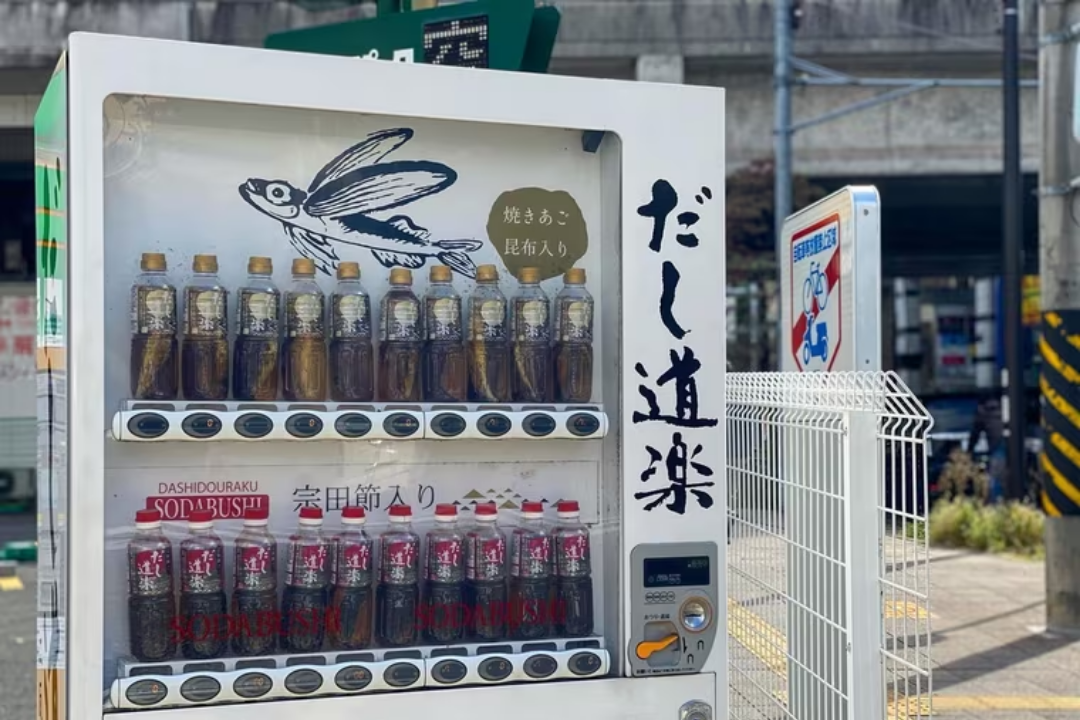
By installing refrigerated vending machines dedicated exclusively to liquid dashi, Futanda Shoyu created a 24-hour purchasing infrastructure for a product category that traditionally lived on supermarket shelves.
These machines are not simply promotional tools. They function as a direct-to-consumer sales model that bypasses traditional retail channels while strengthening local brand recognition.
For a small regional producer, avoiding direct competition for supermarket shelf space can be a powerful long-term strategy. Dashi Douraku is not simply selling seasoning. It is selling a system designed to bring dashi back into everyday life. The true innovation lies not in the taste itself, but in the redesign of the process behind it.
From the Seasoning Aisle to Part of the Streetscape
The impact of Dashi Doraku's vending machines cannot be measured by sales numbers alone. What changed first was the position of dashi itself as a product category.
Traditionally, dashi was simply another item sitting on a supermarket shelf. Dashi Doraku's dedicated vending machines, installed along roadsides and in neighborhoods, transformed it into something visible and memorable. Suddenly, dashi was no longer hidden inside the seasoning aisle. It became part of the urban landscape.
The first machines appeared primarily in Hiroshima, but the network gradually expanded across Japan. The ability to purchase authentic dashi 24 hours a day proved practical for both restaurants and households. At the same time, the unusual concept attracted attention on television, in newspapers, and across social media, eventually turning some vending machine locations into destinations for curious visitors and tourists.
The idea of traveling somewhere specifically to buy dashi is unusual almost anywhere in the world. Yet that is exactly what happened.
From a restaurant perspective, liquid dashi that consistently reproduces authentic flavor while reducing preparation time offers significant operational advantages. This is particularly valuable for smaller restaurants and businesses facing labor shortages. Eliminating the need to prepare stock from scratch reduces workload while maintaining a professional level of flavor consistency.
Why the Future of Home Cooking is Hiding in a Vending Machine
The vending machine model also reshapes distribution itself. Instead of relying entirely on wholesalers and retailers, the manufacturer can communicate directly with customers. Sales and brand awareness happen simultaneously, creating a customer acquisition model that depends less on traditional advertising budgets.
Dashi Doraku's vending machines are not simply an additional sales channel. They represent an attempt to move seasonings closer to public infrastructure, creating new options for both households and professional kitchens.
Quality Control Built on Traditional Brewing Expertise
Source: Dashi Douraku Homepage
Nitanda Shoyu Co., Ltd. began as a soy sauce manufacturer, and soy sauce production requires meticulous management of ingredients, fermentation, temperature, and sanitation over extended periods of time.
Dashi Doraku builds upon this foundation.
Ingredients such as grilled flying fish and kelp directly determine the final flavor profile, making ingredient selection, preparation, and steeping processes critical. Liquid dashi is more sensitive to temperature fluctuations and storage conditions than powdered products, making distribution design an essential part of product development.
This explains why Dashi Doraku uses refrigerated vending machines rather than conventional ambient-temperature vending systems. Refrigeration is not an added convenience but a prerequisite for preserving quality. Temperature management and replenishment schedules are carefully designed to maintain product consistency.
Production also remains rooted in Hiroshima Prefecture, allowing the company to utilize local resources while maintaining close oversight of ingredients and manufacturing. Unlike mass-market national brands, the emphasis is placed on ingredient quality and flavor consistency rather than production volume.
The Business Logic Behind Japan’s Grilled Fish Vending Machines
For international expansion, compliance with food safety standards, labeling regulations, and cold-chain logistics becomes essential. Liquid dashi products hold considerable export potential, but storage conditions and transportation systems must be carefully considered.
Dashi Doraku's refrigerated distribution model demonstrates that product design and logistics can be integrated into a single quality strategy.
The product's success is not built solely on novelty. It is supported by decades of fermentation expertise combined with rigorous ingredient and temperature management.
A Regional Soy Sauce Brewery's Commitment to Protecting Umami
Nitanda Shoyu occupies a very different position from Japan's major food manufacturers.
Based on the island city of Etajima in Hiroshima Prefecture, the company is a regional soy sauce brewery operating in a market dominated by large-scale production and intense price competition. Survival required differentiation.
The company chose to compete not on price, but on umami.
By extending the flavor engineering expertise developed through soy sauce production into the world of dashi, Nitanda Shoyu repositioned itself from being merely a seasoning producer to becoming a company supporting the very foundations of Japanese cuisine.
Its vending machine strategy was never simply a marketing gimmick.
Why Japan’s Dashi Vending Machines are More Than a Gimmick
For smaller businesses, limited advertising budgets and dependence on major retail chains create structural disadvantages. Vending machines offered a rational alternative by allowing direct customer engagement. The machines themselves became advertisements, landmarks, and brand symbols.
At the core of the company's philosophy lies a simple objective: preserving authentic flavors for future generations.
As home cooking becomes increasingly simplified, the goal is not to eliminate culinary processes entirely but to relocate part of those processes into the product itself. This approach allows cultural preservation and modernization to coexist.
Nitanda Shoyu's strategy is not centered exclusively on scale and expansion. Instead, it focuses on sustainability through regional resources and distinctive business models.
Dashi Doraku represents perhaps the clearest expression of that philosophy.
When Washoku Meets the Disappearance of Cooking Time
Source: Dashi Douraku Official Website
Japanese households have experienced significant changes over the past several decades. As dual-income households have become increasingly common, the amount of time spent preparing meals at home has steadily declined.
At the same time, demand for healthier foods, fewer additives, and higher-quality ingredients has grown stronger.
Modern consumers increasingly want convenience and authenticity simultaneously.
Washoku, traditional Japanese cuisine, is recognized as a UNESCO Intangible Cultural Heritage, yet one of its most important foundations, preparing dashi from scratch, is gradually disappearing from everyday life.
As a result, a generational divide is emerging between those who grew up with homemade stock and those raised primarily on instant granules and powdered seasonings.
Dashi Doraku attempts to bridge that gap.
The Flying Fish in the Bottle
Rather than eliminating the process entirely, it seeks to return something close to authentic dashi flavor to the household kitchen. The visible flying fish inside the bottle also serves another purpose by reminding younger generations where flavor actually comes from.
The vending machine model connects naturally with another uniquely Japanese phenomenon: the country's extensive vending machine infrastructure.
Japan is one of the world's largest vending machine markets, with products ranging far beyond beverages. Dashi Doraku leveraged this existing infrastructure and transformed seasoning into something that belongs in the public landscape.
Viewed within the context of Japanese society, Dashi Doraku represents an effort to preserve disappearing culinary experiences while adapting them to modern lifestyles.
That flexibility may be one reason regional producers continue to remain relevant.
How Far Can Japan's Umami Culture Travel?
The potential of Dashi Doraku extends well beyond Japan.
The term "umami" has become widely recognized internationally, and global interest in Japanese cuisine continues to grow. Yet dashi remains difficult for many overseas consumers because preparing it traditionally requires specialized ingredients, techniques, and knowledge.
Liquid dashi offers a way to lower those barriers.
The simple dilution-based format makes it accessible even for users with little experience in Japanese cooking. The visible grilled flying fish inside the bottle also provides a storytelling element that helps distinguish the product in international markets.
Saving a Culture Through Convenience
From a B2B perspective, liquid dashi offers clear benefits for Japanese restaurants and Asian restaurants overseas. It allows kitchens to maintain flavor consistency regardless of staff experience levels while reducing preparation time and labor requirements.
At the same time, global demand for natural ingredients and minimally processed foods continues to rise, making ingredient-forward products increasingly attractive.
Export challenges remain, particularly regarding refrigeration requirements, food labeling standards, and local logistics infrastructure. However, improvements in cold-chain distribution around the world are steadily lowering these barriers.
What Dashi Doraku ultimately demonstrates is a method of packaging Japanese culinary knowledge itself.
Rather than exporting every traditional process, the product embeds much of that process into the product design, allowing the experience of Japanese umami to travel more easily across borders.
This concept could potentially be applied to many other categories within Japanese food culture.
Proven Through Demand Rather Than Advertising
Dashi Doraku is not a short-lived novelty product created through media exposure.
Starting in Hiroshima Prefecture, the company's vending machine network gradually expanded throughout Japan. Television appearances, newspaper coverage, and online media helped raise awareness, but the continued growth in installations suggests sustained consumer demand rather than temporary popularity.
Particularly noteworthy is the fact that a regional brand successfully expanded vending machine locations into major urban areas.
Some consumers now travel specifically to purchase Dashi Doraku after discovering it through social media posts or travel recommendations. This kind of destination-driven purchasing behavior is extremely unusual for seasoning products.
The Small Brewery That Turned Dashi Into Infrastructure
Nitanda Shoyu also operates directly managed stores and restaurants where customers can experience the products in actual dishes. This strengthens the brand by connecting products with culinary experiences rather than limiting them to retail shelves.
The company lacks the scale of publicly traded corporations or major institutional partnerships, but its strength lies elsewhere: long-term sustainability supported by local production and real consumer demand.
Dashi Doraku is not a brand built primarily through advertising investment. It is a brand built through repeat purchases and customer behavior. That may be its strongest proof of value.
Conclusion
Dashi Doraku is far more than a liquid seasoning product.
It is a distribution model designed by a traditional soy sauce brewery seeking to adapt one of Japan's culinary foundations to modern life.
Whole grilled flying fish remain visible inside the bottle, while refrigerated vending machines provide access around the clock. Together, these choices redesign both flavor delivery and product distribution.
For overseas businesses, several lessons stand out:
Japanese umami culture has been packaged in a way that includes the cooking process itself.
Direct-to-consumer distribution can simultaneously strengthen branding and sales.
Regional small and medium-sized businesses can still create meaningful innovation in distribution and retail.
Potential partnerships could take many forms, including supplying restaurant chains, co-branded products with overseas companies, or even adapting refrigerated vending machine models for international cities. For Japanese producers, these partnerships create opportunities for cultural export and market expansion.
For international businesses, they offer access to differentiated, authentic umami solutions. Ultimately, Dashi Doraku is not trying to win more shelf space in the seasoning aisle. Its ambition is larger than that.
It seeks to return dashi to the center of everyday cooking by embedding traditional processes into modern products rather than eliminating those processes altogether. In a society increasingly defined by efficiency and demographic change, this may represent one approach to preserving culinary culture without resisting modernization.
Nitanda Shoyu's achievement demonstrates that even a small regional producer can reshape distribution systems and consumer behavior. By turning dashi into part of the streetscape, the company has also created a new path for the future of Japanese food culture.
FAQ About Dashi Douraku
1. What Is The Dashi Doraku Vending Machine Service?
The Dashi Doraku vending machine is a dedicated liquid dashi vending system operated by Hiroshima-based soy sauce producer Nitanda Shoyu. It allows customers to purchase authentic Japanese dashi made with ingredients such as grilled flying fish (yakiago) and kelp at any time of the day or night.
Rather than limiting premium dashi to specialty stores or supermarket shelves, the company introduced a new way of distributing traditional Japanese flavors directly within local communities and city streets.
2. How Is Dashi Doraku Different From Ordinary Dashi Products?
The biggest difference is visibility.
Dashi Doraku allows customers to see the actual ingredients inside the bottle, including whole grilled flying fish. This makes it immediately clear where the umami flavor comes from and creates a stronger connection between the product and its ingredients.
The product communicates not only flavor but also the producer's philosophy and commitment to traditional Japanese dashi culture.
3. Why Sell Dashi Through Vending Machines?
The goal was to make authentic dashi more accessible in everyday life.
Preparing dashi from scratch requires time, ingredients, and knowledge that many households no longer have. A vending machine allows customers to purchase premium dashi whenever they need it without planning a special shopping trip.
The idea was to reposition dashi as an everyday cooking staple rather than a specialty seasoning reserved for experienced cooks.
4. Why Is A Whole Flying Fish Placed Inside The Bottle?
The whole fish serves as a visual representation of the product's ingredients and value.
Many modern seasonings hide the raw materials and production process from consumers. By placing an entire grilled flying fish inside the bottle, Dashi Doraku visually demonstrates how umami is created and highlights one of the central ideas behind Japanese dashi culture.
It transforms the ingredient itself into part of the product experience.
5. What Types Of Dishes Can Dashi Doraku Be Used For?
Dashi Doraku can be used in a wide range of Japanese dishes, including:
- Udon noodle soup
- Miso soup
- Simmered dishes
- Hot pot meals
- Noodle broths
- Sauces and seasonings
Because it only needs to be diluted with water or hot water, users can achieve authentic Japanese flavors without spending hours preparing stock from scratch. It is used by both home cooks and professional kitchens.
6. Why Is The Dashi Doraku Vending Machine Important For Regional Businesses?
The vending machine model allows producers to connect directly with customers without relying entirely on large retail chains or wholesalers.
The machine itself functions both as a point of sale and as a marketing tool that introduces the brand to new customers. As a result, Dashi Doraku has become an example of how regional businesses can create unique distribution strategies and build strong customer relationships through innovation.
7. Why Did The Dashi Doraku Vending Machines Become So Popular?
Part of the appeal comes from the unexpected nature of the idea itself.
Most people expect to buy seasonings from supermarkets, not from vending machines located on streets or roadsides. The unusual sales method immediately attracted attention.
The striking appearance of bottles containing whole grilled flying fish also made the product highly shareable on social media and in news coverage. In many ways, the distribution method became part of the product's identity.
8. What Makes Dashi Doraku Appealing To Overseas Audiences?
Dashi Doraku offers an easy way to experience Japan's umami culture. Although dashi forms the foundation of Japanese cuisine, sourcing ingredients and learning traditional preparation techniques can be difficult outside Japan.
By incorporating much of the cooking process into the product itself, Dashi Doraku makes authentic Japanese flavors easier to recreate even for users with little prior knowledge of Japanese cooking.
9. What New Ideas About Food Distribution Does Dashi Doraku Represent?
Dashi Doraku demonstrates that changing where products are sold can also change how consumers discover them. Vending machines allow seasonings to become more than just items on a shopping list. They create opportunities for spontaneous discovery in everyday environments.
The concept highlights how innovation in distribution can become just as important as innovation in the product itself.
10. What Is The Greatest Strength Of The Dashi Doraku Vending Machine?
Its greatest strength is its ability to adapt traditional dashi culture to modern lifestyles. Rather than allowing authentic dashi preparation to disappear because it requires too much time and effort, Dashi Doraku incorporates much of that process directly into the product.
By combining centuries-old culinary traditions with modern distribution methods, the company has created a model that preserves Japanese food culture while making it easier to enjoy in everyday life.
Related Videos
If you're interested in Japan's unique food innovations, the video below explores Futanda Shoyu's Dashi Douraku vending machine, which makes authentic dashi broth easily accessible for everyday cooking. This video highlights how a traditional Japanese seasoning has been transformed into a convenient part of daily life through creative distribution.