The N700S Business Booth is a semi-private workspace installed onboard selected N700S Shinkansen trains, Japan's flagship high-speed rail service. Designed for business travelers, it provides a dedicated space where passengers can participate in online meetings, make phone calls, and focus on work without worrying about surrounding noise or distractions. In doing so, it challenges the long-held idea that travel time is unproductive time.
The service is operated by Central Japan Railway Company (JR Central), the operator of the Tokaido Shinkansen. While Japan's bullet trains have long been recognized worldwide for their punctuality, safety, and reliability, the Business Booth adds another layer of value by transforming the train into a practical mobile workplace. Careful attention to privacy, quietness, and usability reflects the meticulous design philosophy that Japanese transportation is known for.
This concept is becoming increasingly relevant for international audiences. As remote work and hybrid work become standard across many industries, professionals are looking for ways to stay productive while traveling. For executives, consultants, sales teams, and anyone who frequently travels between cities, having a secure, distraction-free workspace during transit can significantly improve efficiency.
Rather than simply transporting passengers from one destination to another, the N700S Business Booth redefines the train as a place where meaningful work can happen. It is an innovative Japanese approach to modern mobility that offers valuable ideas for businesses, railway operators, and transportation planners around the world.
N700S Business Booth Overview
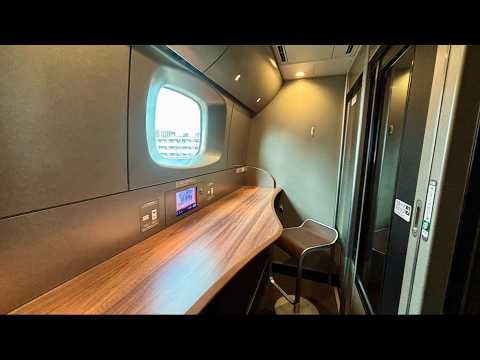
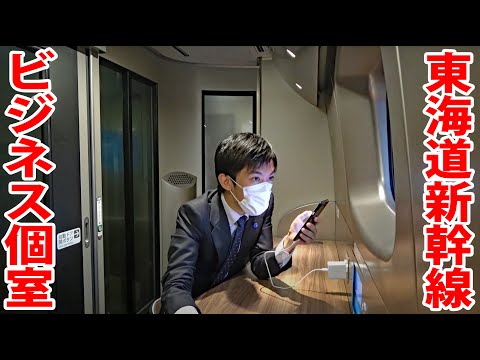
The N700S Business Booth is a reservation-only semi-private workspace available on selected N700S Shinkansen trains operated by JR Central. Created specifically for business travelers, it provides a quiet environment where passengers can continue working while traveling between major cities, transforming the bullet train from simply a means of transportation into an extension of the workplace.
The booth is designed for practical business use. Passengers can work on presentations, answer emails, prepare reports, or participate in online meetings with greater privacy than is possible from a standard train seat. The semi-private design helps reduce visual distractions and minimizes concern about disturbing nearby passengers, making it suitable for tasks that require concentration.
Using the service is straightforward. Travelers reserve the Business Booth when booking eligible Shinkansen services and use the booth during their assigned time slot. It is particularly useful for professionals traveling between Tokyo, Nagoya, and Osaka who want to maximize productivity before arriving for meetings, negotiations, or client visits. It is equally valuable for anyone who simply wants uninterrupted time to complete important work.
The Business Booth requires an additional usage fee on top of the standard Shinkansen fare and limited express ticket. Pricing varies depending on the reservation conditions, positioning the service as a premium option for travelers who value productivity, privacy, and efficient use of their travel time.
What Is the N700S Business Booth?
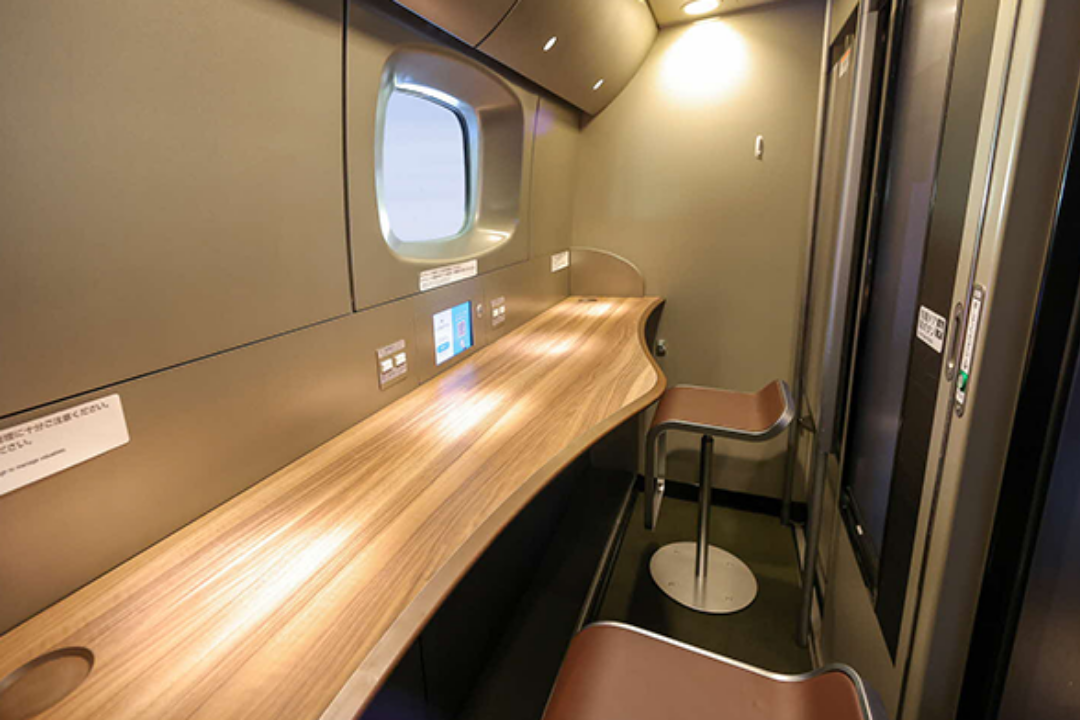
Source: JR Central Homepage
The most distinctive aspect of the N700S Business Booth is that it introduces a genuine workspace into one of the world's busiest public transportation systems. While Japan's Shinkansen has always been a comfortable place to read documents or answer emails, conducting confidential online meetings or handling sensitive business conversations was often impractical in regular seating.
The Business Booth addresses those limitations by intentionally designing a space where passengers can work without unnecessary distractions. Instead of treating onboard work as an afterthought, JR Central created an environment specifically intended for productive business activities.
Why a Dedicated Workspace Works Inside a Public High-Speed Train
From an engineering perspective, the booth has been designed for the unique operating conditions of a high-speed train. The layout takes into account the train's vibration, noise levels, and limited interior space while providing greater privacy than standard seating. Achieving this balance requires expertise in both railway engineering and interior space design, making it a natural extension of JR Central's experience operating one of the world's most advanced high-speed rail networks.
The concept also reflects an important aspect of Japanese business culture: making effective use of time. Rather than viewing travel as downtime, many professionals seek ways to remain productive throughout the day. The Business Booth embodies this mindset by removing the traditional boundary between travel time and work time.
For users, the benefits are immediate. The ability to attend virtual meetings, finalize presentations, or prepare for important negotiations before arriving at a destination makes business trips more efficient. Instead of waiting until reaching the office or hotel, passengers can accomplish meaningful work while traveling, increasing the overall value of the journey.
Practical Value for Industries That Depend on Intercity Travel
The N700S Business Booth is designed for a wide range of industries where traveling between cities is a routine part of business. Consulting firms, technology companies, financial institutions, and real estate businesses are among the most obvious users, as employees frequently move between major commercial centers for meetings, client visits, and project work.
For professionals who regularly travel between Tokyo, Nagoya, and Osaka, one or two hours on the Shinkansen can now become productive work sessions. Instead of losing valuable time in transit, they can prepare presentations, participate in online meetings, or review confidential documents before arriving. This allows tighter schedules and better preparation for important business engagements.
The service also benefits industries such as construction and infrastructure, where managers and engineers often travel between corporate headquarters and project sites. Conducting internal meetings or reviewing project updates during the journey can reduce downtime and accelerate decision making once they arrive.
For companies, the Business Booth offers a practical solution to one of the biggest challenges of business travel: how to make travel time productive rather than idle. By adding a premium workspace to Japan's busiest high-speed rail route, JR Central has created a service that can improve operational efficiency across a wide range of industries.
Balancing Railway Safety With Workplace Comfort
The N700S Business Booth is built on two equally important principles: maintaining the strict safety standards required of public transportation while creating a comfortable environment for productive work. Because the booths are installed inside operating Shinkansen trains, they must meet far higher engineering requirements than a typical office pod or private workspace.
The materials and structural components are selected to withstand continuous high-speed operation, vibration, and long-term daily use. The interior is carefully designed to provide privacy, support comfortable computer work, and allow passengers to remain focused without compromising the train's operational requirements.
Installation is also closely integrated with the overall vehicle design. Every component must work within the existing train structure, passenger flow, and safety systems. Extensive engineering verification ensures that the booths do not interfere with emergency procedures, maintenance operations, or the overall performance of the train. This level of integration reflects JR Central's decades of experience designing and operating one of the world's safest railway systems.
Quality management continues after installation. Regular inspections, cleaning, and equipment checks help maintain a consistently reliable environment for passengers. While the Business Booth is not marketed through international certifications, it operates under Japan's rigorous railway regulations and safety standards, providing users with confidence that productivity never comes at the expense of safety.
A Japanese Model That Combines High-Speed Rail and Modern Workstyles
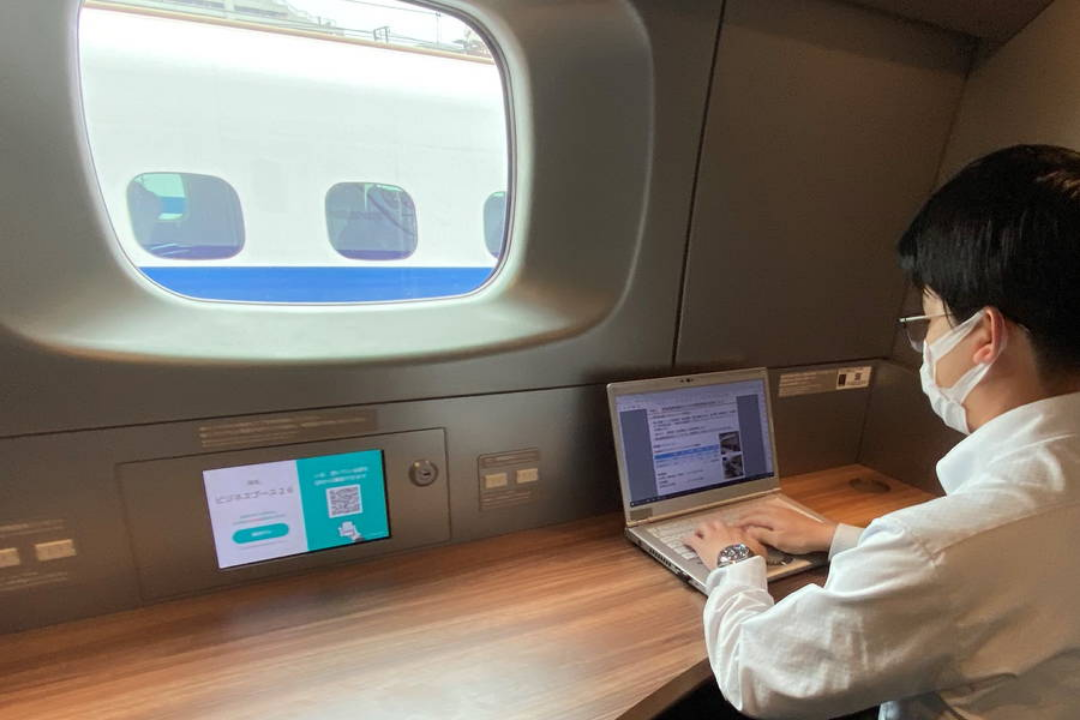
Source: JR Central Homepage
The N700S Business Booth is more than an innovative service for Japan's domestic market. It also offers a concept with strong potential for international adoption. The core idea is simple: providing a space where passengers can work productively while traveling at high speed. That need is increasingly universal, regardless of country or business culture. In regions where intercity travel is common, improving the productivity of travel time has become an important priority.
Markets with well-developed high-speed rail networks are particularly well suited to this concept. Countries such as China, Taiwan, South Korea, France, and Germany already rely heavily on rail for business travel, and many professionals want to complete work before arriving at their destination. In these markets, an onboard workspace like the N700S Business Booth could become a valuable premium service.
The concept is also culturally adaptable. As remote work and hybrid work become standard across the globe, professionals are increasingly comfortable working from private or semi-private spaces outside traditional offices. A workspace that allows passengers to focus while remaining considerate of others in a shared public environment has broad international appeal.
Japan's Shinkansen already enjoys a global reputation for safety, punctuality, and quiet, comfortable travel. Built on that foundation, the N700S Business Booth demonstrates how high-speed rail can evolve beyond transportation into a productive work environment. It is a practical Japanese model that has the potential to inspire railway operators around the world.
Why JR Central Is the Leading Example
JR Central is uniquely positioned to develop the N700S Business Booth because the service is deeply integrated into its core business of operating the Tokaido Shinkansen. Unlike an add-on created by an outside vendor, the Business Booth was conceived, designed, and implemented by the railway operator itself based on a deep understanding of passenger behavior and business travel patterns.
Because JR Central operates one of the world's busiest intercity rail corridors, it understands the needs of travelers who regularly work while moving between Tokyo, Nagoya, and Osaka. This insight made it possible to introduce dedicated workspaces that address real business challenges rather than simply offering another premium seating option.
Balancing Focus and Privacy in Public Transit
The company's greatest strength lies in decades of experience delivering safe, reliable, and high-frequency high-speed rail services. The Tokaido Shinkansen carries more passengers than any other high-speed rail line in Japan and is internationally recognized for its exceptional punctuality and operational reliability. Built on this foundation, the Business Booth is designed not as a luxury upgrade but as a service that increases the value of travel time itself.
Compared with other transportation providers, JR Central occupies a distinctive position. Airlines and other travel operators offer premium seating, but very few provide permanently integrated semi-private workspaces while maintaining the strict operational standards required for public transportation. By redefining railway travel as an opportunity for productive work, JR Central has established itself as a pioneer in this emerging category.
The Social Changes That Made the Business Booth Possible
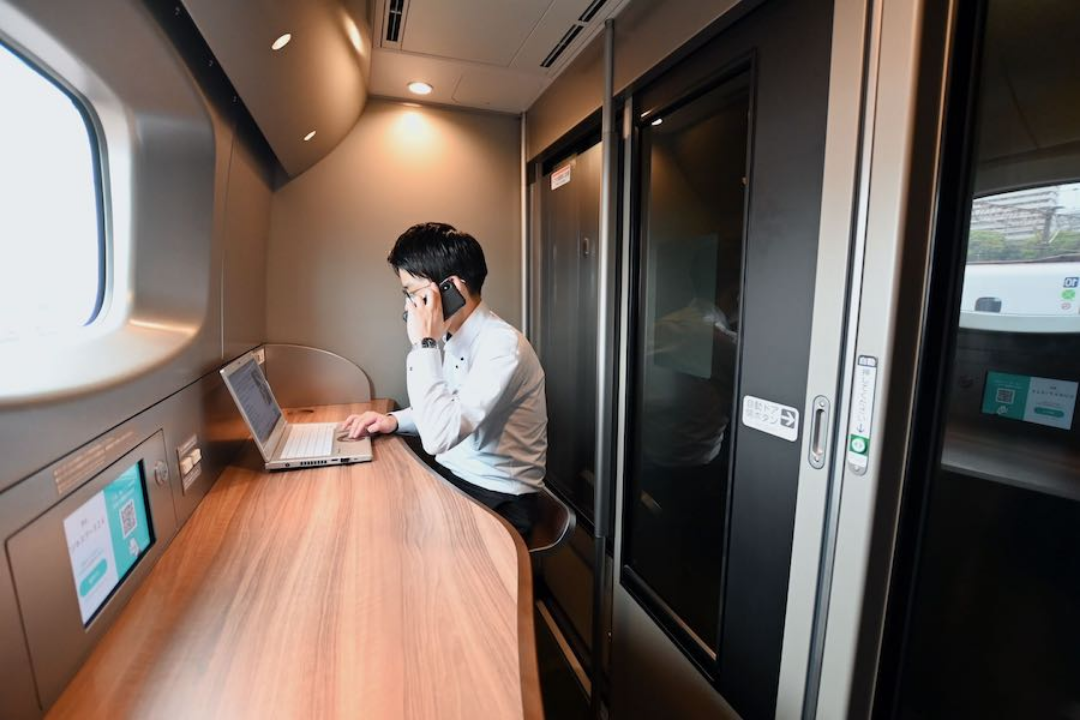
Source: JR Central Homepage
The N700S Business Booth emerged in response to major changes in how people work and travel. As remote work and online meetings became commonplace, the traditional assumption that productive work could only happen in an office began to disappear. However, time spent traveling between cities often remained one of the few periods during the workday when productivity slowed.
For frequent business travelers, long Shinkansen journeys were often viewed as unavoidable downtime. While passengers could answer emails or review documents, holding confidential discussions or participating in virtual meetings from a standard seat was often impractical.
The railway industry also faced this challenge. Although high-speed rail had already reached world-class levels of speed, reliability, and punctuality, the onboard working environment had changed very little over the years. Standard seating simply was not designed for the demands of modern digital work.
Recognizing this shift, JR Central began viewing the Shinkansen not only as a transportation system but also as a place where value could be created during the journey itself. The result was the N700S Business Booth, a dedicated workspace that allows passengers to remain productive while traveling. By integrating professional workspaces into the train, JR Central aims to improve both productivity and the overall travel experience.
The Business Booth is therefore more than a new onboard feature. It represents the intersection of changing workstyles and the next stage of innovation in high-speed rail services.
Expanding the Value of the Shinkansen
Today, the N700S Business Booth is offered as a premium service on selected trains, but the concept has considerable room to evolve. Future improvements may include more flexible reservation systems, refined operating procedures, and additional features that make the service even easier to use. As business travelers continue adopting new digital workflows, the range of practical use cases is also likely to expand.
From a branding perspective, the Business Booth helps reshape how people think about the Shinkansen. Instead of viewing the train simply as transportation, passengers can begin to see it as a place where important work gets done. In doing so, the service strengthens JR Central's image as an innovator in railway services.
Even if the Business Booth itself is not directly exported overseas, its underlying concept can serve as a model for future high-speed rail systems. Railway operators around the world may find inspiration in the idea of integrating dedicated workspaces into trains, particularly in regions where business travel between cities is common.
Ultimately, the Business Booth is about more than adding another premium option. It represents an effort to increase the value of the entire Shinkansen experience and demonstrates how transportation infrastructure can continue evolving to meet changing business needs.
Growing Recognition Through Media Coverage and User Experience
Since its introduction, the N700S Business Booth has attracted attention across Japan as a service that enhances the value of travel time. Railway publications, business media, and technology outlets have highlighted it as an example of how transportation can adapt to the era of remote and hybrid work. In particular, creating a space for online meetings inside a public high-speed train has been recognized as a significant step beyond traditional railway services.
Although JR Central has not released detailed figures regarding usage or revenue, the limited rollout on selected trains suggests that the company is carefully refining the service through real-world operation. By analyzing demand and passenger behavior, JR Central continues improving the Business Booth based on actual user experience.
On social media platforms such as X and YouTube, business travelers have shared reviews demonstrating how they use the service in practice. Many describe completing meetings before arriving at their destination or achieving a level of focus that would be impossible in standard seating. Rather than attracting attention through novelty alone, the Business Booth has earned recognition because of its practical value.
These experiences reinforce one key message. The Business Booth is not designed to create a luxury experience. It is designed to make productive work feel natural while traveling, fundamentally changing how passengers use their time onboard.
Conclusion
The N700S Business Booth demonstrates how a mature high-speed rail system can create new value by transforming travel time into productive work time. As remote work and hybrid work become standard worldwide, professionals increasingly want to stay productive while traveling rather than treating transit as lost time. By introducing a dedicated workspace into one of the world's busiest high-speed rail networks, JR Central has created a practical solution to that challenge.
The significance of this service extends well beyond Japan. Its value lies not only in the quality of the Shinkansen itself, but in the way it combines world-class railway infrastructure with thoughtfully designed workspaces. This approach offers useful ideas for countries that already operate high-speed rail, as well as those planning future networks.
For railway operators, transportation companies, and infrastructure planners, the N700S Business Booth provides a compelling case study in service innovation. It shows how improving the passenger experience can also create new premium offerings and strengthen the competitiveness of rail travel.
By bringing together mobility and modern workstyles, the N700S Business Booth represents a distinctly Japanese approach to the future of transportation. As global demand for productive travel continues to grow, it stands out as a model that businesses and railway operators around the world can learn from.
FAQ About the N700S Business Booth
1. What Is the N700S Business Booth?
The N700S Business Booth is a reservation-only workspace installed on select N700S Tokaido Shinkansen trains operated by JR Central. Designed with privacy in mind, it provides a semi-private environment where passengers can participate in online meetings or focus on work while traveling. Rather than treating the Shinkansen as only a means of transportation, the service transforms it into a productive workspace for business travelers.
2. How Is It Different From Working in a Regular Seat?
The biggest difference is that the Business Booth makes it much easier to conduct conversations without worrying about surrounding passengers. While passengers can comfortably use a laptop at a regular seat, online meetings and phone calls often require extra consideration for others nearby. The N700S Business Booth provides a dedicated space where travelers can work whenever they need to during the journey.
3. Why Was a Dedicated Workspace Introduced on the Shinkansen?
The concept was created in response to changing work styles and the growing demand to make better use of travel time. As remote work and online meetings have become more common, professionals increasingly work outside traditional offices. The N700S Business Booth helps ensure that time spent traveling between cities no longer has to be time when work comes to a stop.
4. How Is It Different From the New Private Compartment Seats?
The two services serve different purposes. The upcoming private compartment seats are designed to provide passengers with an exclusive space for the entire journey, while the N700S Business Booth is intended as a workspace that can be reserved only when needed. Instead of replacing your seat, it offers a dedicated area for meetings, phone calls, or focused work during part of your trip.
5. Who Is the N700S Business Booth Designed For?
It is particularly useful for business travelers who need to attend online meetings while traveling or who have presentations, client meetings, or negotiations immediately after arriving. By reviewing documents and completing preparation during the trip, passengers can make better use of their time after reaching their destination. It is especially valuable for professionals who frequently travel between major cities.
6. What Makes Creating a Workspace on Public Transportation Challenging?
The challenge is balancing a comfortable working environment with the strict safety standards required for high-speed rail. Unlike an office, a train must account for limited space, passenger movement, and vibration while traveling at high speed. The N700S Business Booth was specifically designed to provide a practical workspace while operating within the unique conditions of the Shinkansen.
7. How Does the N700S Business Booth Change the Way People Work?
It challenges the traditional idea that travel time and working time should be separate. In the past, many professionals waited until arriving at their destination to begin meetings or complete important tasks. By allowing passengers to prepare, collaborate, and work while traveling, the Business Booth supports a more flexible way of working that is less dependent on location.
8. Why Is the N700S Business Booth Appealing to International Audiences?
Its biggest appeal is that it reimagines high-speed rail as a productive workplace rather than simply a mode of transportation. As remote and hybrid work become increasingly common worldwide, improving productivity during travel has become a shared challenge. By combining the Shinkansen's reputation for safety, punctuality, and reliability with a dedicated workspace, the service offers an innovative model that railway operators around the world may find valuable.
9. How Does the N700S Business Booth Change Railway Services?
It expands the value of rail travel beyond simply reaching a destination quickly. The service encourages passengers to view travel time as productive time rather than downtime, giving the journey itself a new purpose. In doing so, it demonstrates how transportation services and modern work styles can be integrated more effectively.
10. What Is the Biggest Advantage of the N700S Business Booth?
Its greatest strength is that it reduces the productivity lost during travel by allowing passengers to work where and when they need to. Rather than introducing an entirely new mode of transportation, it increases the value of time already spent aboard the Shinkansen. By naturally combining mobility and productivity, the N700S Business Booth offers a compelling vision for the future of business travel.
Related Videos
If you're interested in how Japan is transforming train travel for business professionals, the video below introduces the N700S Business Booth, a private workspace designed for productivity on the Shinkansen. This video shows how dedicated workspaces are helping travelers make better use of their time while commuting.