A Groundbreaking Japanese Invention to Protect the Visually Impaired: The Power of Tactile Paving Blocks
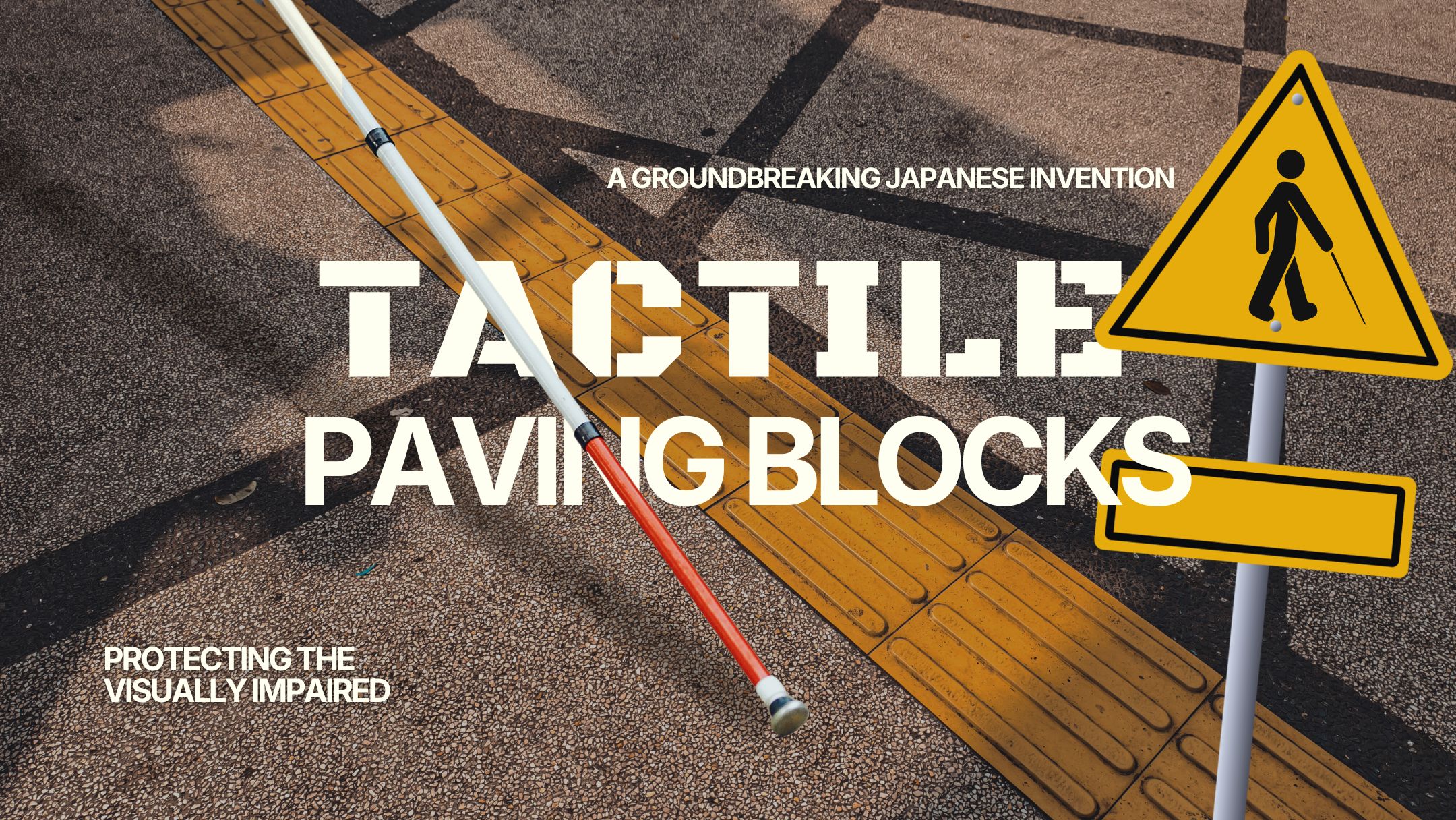
You’ve likely seen those yellow blocks with raised patterns at train stations or on sidewalks across Japan. Known as tactile paving or “Tenji blocks,” these distinctive tiles were developed in Japan in the 1960s to help people with visual impairments detect direction and danger through the soles of their feet or a white cane. They represent one of the world’s first pedestrian guidance systems designed specifically for those with vision loss.
The idea originated with Seiichi Miyake, an inventor from Okayama Prefecture. After experiencing a traffic accident himself, Miyake was inspired to create a society where everyone could move safely and confidently. In 1965, he developed the first tactile block. A year later, it was installed on a sidewalk in Okayama, marking the start of an invention that would quietly revolutionize urban safety, first in Japan, then around the world.
At the time, there were almost no systems in place to help people with visual impairments navigate safely. Everyday activities, such as commuting to school or work, shopping, or simply walking outside, were only possible with assistance from others. Tactile paving provided a concrete solution to the broader goal of promoting independence for the visually impaired.
The simple desire to give everyone the ability to walk safely—something most of us take for granted—led to this invention, which has since reshaped how cities are designed and how public spaces account for diverse needs.
That small raised surface isn’t just for people with visual impairments either. It’s also a quiet question directed at society as a whole. Sometimes it’s precisely because something isn’t visible that we’re prompted to notice it. Design that doesn’t rely on sight can reveal human warmth in unexpected ways—and that’s the kind of value embodied in tactile paving.
This article explores the design and types of tactile paving, its development and global spread, its current role in society, and the challenges it still faces. It’s a look into the impact and future of this quiet but powerful Japanese innovation.
Tactile Paving Overview
Tactile paving generally comes in two distinct types:
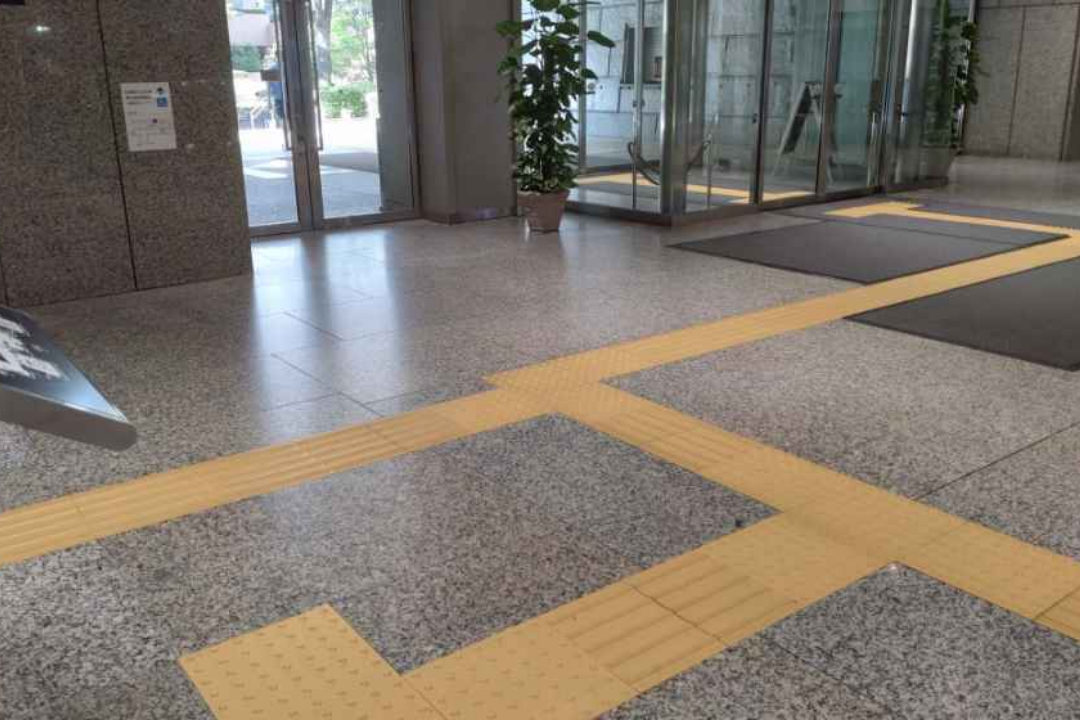
- Guiding blocks (with linear ridges): These indicate a safe direction of travel.
- Warning blocks (with raised dots): These alert users to hazards or areas where they should stop, such as stairways, intersections, or platform edges.
Both types are designed to be recognized intuitively through a cane or by foot. They are commonly produced in yellow, a high-contrast color that’s easier to distinguish even for individuals with color vision deficiencies.
- First installation: March 18, 1967, in front of Okayama National Hospital
- Inventor: Seiichi Miyake, from Okayama Prefecture
From Japan to the World: How Tactile Paving Spread
Source: Tokyo Metropolitan Government – Barrier-Free Mind Initiative
When tactile paving was first introduced, it was a local experiment limited to Okayama. The 1967 installation was a symbolic attempt to make it possible for people with visual impairments to walk outside safely and independently.
At first, the blocks were unfamiliar to many, and it took time for residents and passersby to understand their purpose. But as visually impaired individuals and caregivers began to experience their effectiveness, the word quickly spread. Coverage in local newspapers and word of mouth helped raise awareness that “those yellow blocks have meaning.”
Early Adoption and Cultural Shift
Soon, the paving was installed at hospitals, schools for the blind, bus stops, and shopping centers throughout Okayama. This early wave of adoption symbolized a broader cultural shift in Japan—an emerging value system that emphasized the importance of consideration for needs that aren’t always visible.
By the 1970s, thanks to growing support from local governments and disability organizations, the paving began to spread beyond Okayama. Eventually, the Japanese national government also recognized its value.
In 1985, the Ministry of Transport (now the Ministry of Land, Infrastructure, Transport and Tourism) issued official guidelines for installing tactile paving. The push to standardize its use across public transportation networks began in earnest.
Policy Support and Nationwide Integration
The momentum continued with the introduction of barrier-free policies in 1988 and the enactment of the 1991 Transportation Accessibility Improvement Law, which promoted mobility for the elderly and disabled. These developments firmly established tactile paving as a nationally recognized and standardized element of urban infrastructure.
Installation expanded into rural towns and smaller cities, and today, tactile paving can be found in a wide variety of locations, from train stations and commercial areas to tourist destinations. In particular, partnerships with public transportation providers like JR Group, urban rail systems, and bus companies have ensured that tactile paving is now a standard safety feature on train platforms across the country.
Today, it’s more challenging to find a train platform in a major Japanese city without tactile paving than to find one with it. It has become a visible representation of inclusive design and collective empathy, deeply rooted in Japanese urban life.
Supporting Independence Through Infrastructure
It also marked the moment when “freedom of movement” began to be supported by public systems. Creating spaces where people with visual impairments can feel confident walking, whether in a train station or on a city street, goes beyond infrastructure. It represents a shared social commitment. Ensuring safe mobility means safeguarding daily life, ultimately preserving one’s independence.
The national and local governments took increasing interest in tactile paving’s potential during the 1980s. Backed by official guidelines from the Ministry of Transport and later by national legislation like the Barrier-Free Law, installations gained serious momentum. The paving began appearing at crosswalks, public buildings, transportation hubs, and other high-traffic areas.
By the 1990s, improvements in welfare policy—including the revised 1991 Barrier-Free Transportation Law—enabled local governments and transportation operators to collaborate and accelerate installations at airports, train stations, and other essential public spaces.
Today, the paving is so widely implemented that it’s virtually impossible to find a station platform in Japan without it. Tactile paving has become an integral part of Japan’s transportation safety infrastructure—a vital “invisible safety device” that quietly protects and empowers those who need it most.
How Tactile Paving Is Used in Public Spaces
Tactile paving is a square-shaped guidance system installed on the ground or floor to help people who are blind or have low vision move safely. Its official name is tactile ground surface indicators for persons with visual impairments.
There are two main types of tactile paving commonly seen in public spaces. The first is guidance blocks, which feature raised linear patterns that indicate the direction of travel. The second is warning blocks, which have raised dot patterns and are used to signal hazards or important locations.
Guidance blocks are widely used to assist safe navigation by indicating direction through the sensation felt underfoot. They are installed in locations such as train platforms, crosswalks, public facilities, building entrances, areas in front of stairs and ramps, and routes leading to braille guide boards.
Warning blocks are primarily installed at potentially dangerous points, including the edges of train platforms, before crosswalks, at the top and bottom of stairs and slopes, near building entrances, in front of guide boards, and at junctions where guidance blocks branch. They can be found throughout public transportation systems, facilities, and roadways.
Tactile paving is especially widespread in Japan and plays an essential role in supporting independent mobility for people with visual impairments.
The Role and Challenges of Tactile Paving Today
In modern cities, tactile paving plays a crucial role in supporting both the safety and independence of people with visual impairments. Warning blocks at platform edges help prevent falls, while guiding blocks laid along sidewalks lead users to their destinations. For those with limited or no vision, tactile paving serves as a physical signpost, something that can be felt, trusted, and followed.
Tactile Guidance in Everyday Urban Life
In today’s urban environments, tactile paving has become essential for daily navigation. For those who can’t rely on sight, these features act as tactile signposts—touch-based tools that make everyday travel possible.
Design Questions for the Future
At the same time, important questions are emerging: how should tactile paving be installed in flat spaces without curbs? What materials and heights best allow electric wheelchair users to pass safely? Creating opportunities for discussion and collaboration across different perspectives will be key moving forward. Starting from one person’s difficulty, we can rethink comfort for everyone. Tactile paving serves as a symbol of that shift, encouraging dialogue between cities and the people who live in them.
However, the system still faces challenges. Installation standards can vary by region, leading to inconsistencies. In some cases, guidance paths are incomplete, or different styles of blocks are mixed together in confusing ways.
Other issues include obstruction, bicycles, advertising signs, and other objects placed on tactile blocks that can block passage, or wear and tear, which can reduce the effectiveness of the raised patterns over time.
Balancing Accessibility and Universal Design
In recent years, concerns have also been raised by elderly pedestrians and wheelchair users, who say the raised surfaces can increase the risk of tripping or discomfort. This has led to a growing discussion about how to balance the original purpose of tactile paving with the broader goals of universal design.
To maintain the usefulness of tactile paving while improving walkability for all, a comprehensive approach is needed—one that includes better construction techniques, thoughtful urban planning, and public education.
Tactile paving is a mature technology, but it continues to evolve as society’s needs change. It remains a living, adaptive solution.
The Future of Unseen Design

Source: Tokyo Metropolitan Government – Barrier-Free Mind Initiative
Tactile paving has become a familiar part of Japanese cities. We often walk past it without noticing, but behind its design lies a powerful story of innovation, compassion, and responsibility.
More than 50 years after its invention, tactile paving continues to evolve, both in Japan and abroad. At its core is a simple but profound idea: building a society where everyone can move through public spaces with ease and confidence.
Its importance extends beyond people with visual impairments. Elderly people, children, tourists, and foreigners—all benefit from safe, easy-to-navigate cities. Tactile paving is a key to designing more intuitive and inclusive urban environments.
This yellow path may signal someone’s challenge, but it also reflects our collective compassion. Spreading this awareness is a meaningful first step toward a society that truly embraces diversity. These small yellow blocks embody Japanese wisdom and care—the belief that design and technology can protect people and make society better. By recognizing its value, we can take a small but meaningful step toward creating a future built on empathy, accessibility, and shared responsibility.
The Unspoken Kindness in Everyday Design
Tactile paving doesn’t just exist in Japan’s big cities. It’s also quietly present in familiar, everyday places—at the entrance of a neighborhood grocery store, near a school, at a park gate, or even along a walkway in a hot spring town. Most of the time, people pass by without noticing, but for someone, that path is an essential guide.
The fact that this kind of infrastructure has become such a natural part of the landscape speaks to Japan’s cultural foundation of “unseen kindness.” Without the need for loud explanations, thoughtful design is already in place—an instinctive gesture of care for those who need it. It’s a reflection of the aesthetics of empathy that shape Japan’s public spaces.
In recent years, schools have begun incorporating tactile paving into disaster preparedness programs and classroom lessons. Through questions like “Who is this path for?” children are encouraged to consider the world from someone else’s perspective. Tactile paving is quietly taking on another role—as a learning tool that nurtures empathy from a young age.
International Recognition and Adoption

Source: Tokyo Metropolitan Government – Barrier-Free Mind Initiative
Japan’s tactile paving system has been embraced in many countries as an effective mobility aid for people with visual impairments. Its adoption has been especially notable in Asia.
South Korea began rolling out tactile paving in earnest in the late 1990s, and it is now a familiar sight in urban subways, crosswalks, and bus terminals. While variations exist in color or material depending on the country, the core Japanese design principle—lines for guidance, dots for warnings—has been widely adopted around the world.
In places like Singapore and Hong Kong, tactile paving is included from the city planning stage as part of universal design frameworks. It has been introduced in airports, commercial complexes, and tourist areas.
Even in the UK, Transport for London has implemented Japanese-style tactile paving on some station platforms. Municipalities in countries like Australia and Canada have also begun incorporating the system, tailoring it to local needs.
Internationally, tactile paving is known as Tactile Ground Surface Indicators (TGSI). In 2012, the International Organization for Standardization (ISO) issued ISO 23599, which standardized specifications such as dimensions, materials, layout, and color, solidifying its place as a global standard.
More recently, tactile paving has been re-evaluated as part of inclusive social infrastructure, particularly in connection with the SDGs (Sustainable Development Goals). It’s increasingly cited as a model for designing public spaces that consider the needs of all people—including those with visual impairments—especially within urban planning efforts toward achieving Goal 11: “Make cities and human settlements inclusive, safe, resilient, and sustainable.” This technology, developed in Japan, is now informing international policy and design standards.
Today, tactile paving is appreciated not just as infrastructure, but as a form of non-verbal kindness—an embodiment of empathy that transcends language and culture.
Conclusion
Tactile paving is more than a physical guide. It is an infrastructure of compassion, born from one individual’s vision and supported by an entire society. In Japan, it has already become part of the everyday urban landscape. Yet across the globe, many regions still lack access to this vital technology or have not standardized its use.
Where it has been implemented, the results speak for themselves. People with visual impairments report feeling newly empowered to go to school, commute to work, or run errands independently. Tactile paving has improved not only physical safety, but also psychological well-being, restoring confidence and a sense of independence.
In a world that increasingly values diversity and inclusion, tactile paving stands as a powerful symbol. It’s not just for “someone else,” it’s for all of us. As cities strive to become more livable and accessible, tactile paving has emerged as a globally recognized infrastructure of empathy, one that transcends language, culture, and nationality.
Designing spaces that are easy to navigate for everyone—including visually impaired people, but also the elderly, children, and tourists—is becoming a marker of a city’s maturity. In that sense, tactile paving is not only a “guide for those who cannot see,” but also a quiet prompt to the rest of us to become more aware and thoughtful.
It’s time we took a closer look at what lies beneath our feet. These textured blocks are a reflection of a society built on consideration and care, and they form the foundation for a safer, more inclusive future.
The “yellow path” is not just for the visually impaired. It is a visible trace of the kindness that connects us all in the shared spaces we move through each day.
FAQ About Tactile Paving Blocks
1. What Role Do Tactile Paving Blocks Serve?
Tactile paving blocks function as pedestrian guidance infrastructure for people with visual impairments. By sensing them through the soles of the feet or with a white cane, users can identify direction and potential hazards, supporting safe and independent mobility.
2. What Types Of Tactile Paving Blocks Are There?
There are two main types: linear “guidance blocks” and dotted “warning blocks.” Guidance blocks indicate the direction of travel, while warning blocks alert users to hazards such as steps or intersections. This clear distinction allows for intuitive navigation.
3. Why Are They Yellow?
Yellow is used to enhance visibility. It provides a strong contrast with surrounding surfaces, making it easier to recognize for people with low vision. The design supports both tactile and visual perception.
4. When And By Whom Were They Developed?
Tactile paving was invented in 1965 by Seiichi Miyake. Motivated by his experience with traffic accidents, he aimed to create a society where everyone could move safely. The first installation was in 1967 in Okayama City, in front of the National Okayama Hospital.
5. Why Did They Become Widespread In Japan?
Their practicality and the development of supportive regulations contributed to their widespread adoption. With the introduction of accessibility guidelines and barrier-free policies, they were widely implemented across public transportation systems such as railways and buses.
6. Are They Used In The Same Way Overseas?
Yes, tactile paving has been adopted in many countries. Originating in Japan, it has been standardized under ISO as “Tactile Ground Surface Indicators (TGSI)” and is now used worldwide. While shapes and colors may vary by country, the basic principles remain consistent.
7. What Challenges Exist Today?
Current challenges include inconsistencies in installation across regions and obstructions such as bicycles or signage blocking pathways. In some cases, routes are incomplete, and wear over time can reduce the effectiveness of the surface texture.
8. How Might They Evolve In The Future?
As their widespread use has revealed certain limitations, future developments are expected to focus on more inclusive design. From a universal design perspective, improvements may include optimized materials and placement, as well as integration with digital technologies.
Related Videos
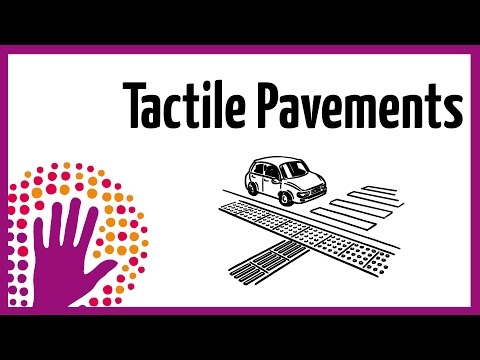
If you're interested in Japan’s approach to accessibility and public design, the video below introduces tactile paving blocks, a system created to support visually impaired pedestrians. This video shows how these textured pathways improve navigation and safety in everyday urban environments.