
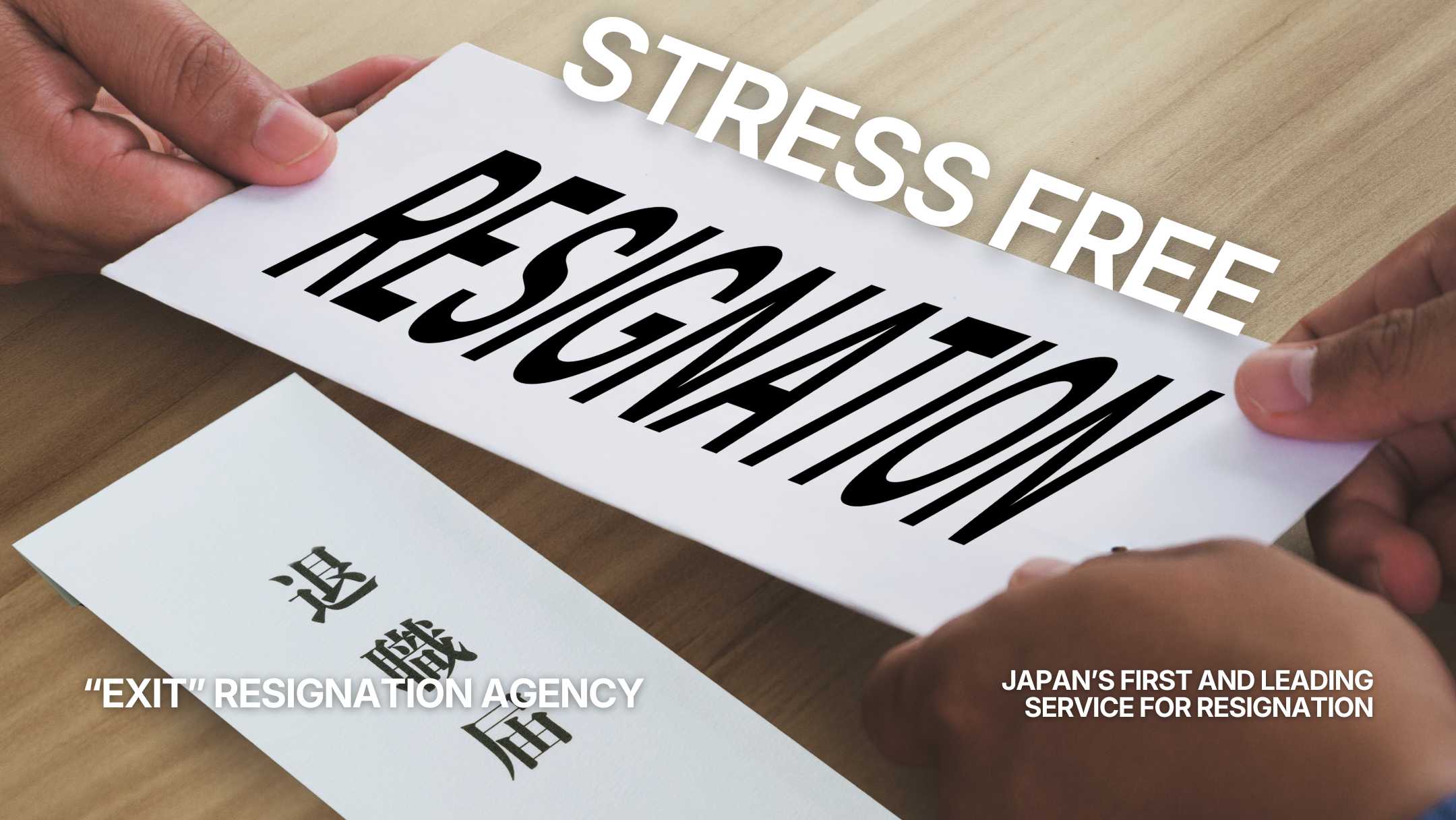
Every morning in Japan, countless employees head to work with heavy steps, telling themselves, “Today I’ll finally quit,” yet unable to summon the courage to say it to their boss. Scenes like this are far from unusual. In Japan’s workplace culture, many people feel a strong psychological barrier to resigning, and it is not uncommon for employees to quietly wear themselves down, unable to bring up the subject at all.
In recent years, however, a new kind of “savior” has emerged for those stuck in the “I just can’t quit on my own” dilemma: EXIT, a professional resignation agency service. Founded in 2018, EXIT was the first company in Japan to specialize in resignation support and has since grown into the industry’s largest provider. Acting on behalf of employees, it not only communicates the intention to resign to the employer but also manages the entire resignation process from start to finish. This unique service has drawn significant media attention and has even become a social phenomenon.
Why would someone pay money to have another person deliver their resignation? The answer lies in the unique workplace relationships and cultural norms found in Japan. A common belief persists that “quitting a company midway is wrong,” combined with fear of reprimand or pressure from a boss to stay. Caught between these pressures, many employees endure their situation until they reach their breaking point.
EXIT’s founder, Toshiyuki Niino, once experienced workplace harassment at his first job after graduation and found himself unable to voice his desire to quit. From that painful experience came the idea: “I want to help people outsource the resignation they cannot bring themselves to say out loud.” That conviction ultimately led to the creation of EXIT.
With EXIT’s emergence, people struggling with the dilemma of “I want to quit, but I can’t say it” gained a new option. Users have commented, “My mental burden was greatly reduced,” and “I was surprised by how effortlessly I was able to resign.”
This article introduces the details and appeal of EXIT’s resignation agency service—covering what the service offers, why it was created, and the impact it has had on Japanese society.
Resignation Agency Service “EXIT” Overview
Japan’s first resignation agency service, EXIT, directly communicates an employee’s intention to resign to their company on their behalf. For those who find it difficult to tell their boss or workplace, EXIT handles all necessary notifications and supports a smooth resignation process from start to finish.
The service offers a flat-rate fee with no additional charges, allowing clients to initiate resignation procedures as early as the same day, all without the need to visit the office. With attentive support that eases client concerns and comprehensive offerings that include post-resignation career assistance, EXIT makes a truly “stress-free resignation” possible.
Why EXIT Stands Out in Japan’s Resignation Industry
EXIT Inc. is a pioneering company that introduced the unprecedented concept of a “resignation agency” to Japanese society. Founded in 2018 by Toshiyuki Niino and Yuichiro Okazaki, the company has been committed from the start to being “an ally for everyone who wants to restart their life,” offering resignation support that helps people take their next step with peace of mind.
Since launching, EXIT has successfully handled more than 10,000 resignations annually; an impressive track record that has become a foundation of trust. Another hallmark of the company is its high level of transparency, exemplified by CEO Niino himself appearing in media interviews to improve the industry’s reputation. Today, EXIT is widely recognized as the leading name in resignation agency services, frequently covered by major television networks and newspapers.
Why Resignation Agency Services Are Needed

Source: EXIT Homepage
Some might think, “If you want to quit your job, just say it yourself.” However, in Japan’s workplace environment, that is often much easier said than done.
According to EXIT’s data, nearly 80% of users are under the age of 30, with the majority in their twenties. Nearly 70% had been with their company for less than a year, suggesting a growing trend of people deciding to resign only a few months after joining.
Even more striking, 60% cited ‘mental health issues’ as their reason for leaving. This highlights a reality in which younger employees, facing excessive stress or workplace harassment, often feel forced to resign early to protect their well-being before reaching a critical point.
At the same time, old-fashioned values such as “persevere for at least three years” or “quitting midway shows a lack of grit” remain deeply rooted in many Japanese companies. Even when young employees express a desire to resign, they are often met with scolding or pressure such as “Don’t run away” or “Think about how much the company invested in training you.” Pressure to stay can also come from colleagues or even family members, leaving individuals with deep internal conflict.
“EXIT’s Service Details and Usage Process
EXIT’s resignation agency service provides continuous support from the initial request all the way to the completion of your resignation. The process is simple and can be completed in just five steps.
1. Free Consultation
First, contact EXIT via LINE, email, or phone. You can explain your situation and any requests you may have, such as “It’s hard to tell my boss directly,” “I want to quit without going back to the office,” or “I’d like my belongings to be sent to my home.”
Consultations are free of charge, and a 24-hour automated LINE response system is available, making it easy to reach out even late at night or on holidays.
2. Filling Out Required Information (Hearing Sheet)
Once you decide to use the service, you’ll fill out a dedicated form with basic information needed for the resignation process. This includes your company’s name and phone number, employment type, supervisor’s name, and the desired date for the resignation agency to take effect (i.e., when you want to stop going to work).
If you have remaining paid leave, you can indicate whether you wish to use it. EXIT handles all employment types, including full-time, contract, temporary staff, and even public servants.
3. Payment of Fees
Next, you pay the quoted fee. EXIT charges a flat rate of 20,000 yen (tax included), paid in advance by bank transfer or credit card. No additional costs are incurred; this single fee covers everything from consultation to execution. A full refund is guaranteed if the resignation cannot be completed.
Compared to rates offered by private agencies or law firms, EXIT’s affordability is a major advantage.
4. Resignation Execution
Once payment is confirmed, EXIT staff will contact your company on the date you specify. They will notify your manager or HR department, for example: “Mr./Ms. XX is resigning effective today.” They also communicate your requests using remaining paid leave, returning personal belongings, or prohibiting further contact.
EXIT does not engage in negotiations; it strictly serves as a “notification and communication” service, ensuring the process proceeds smoothly and within legal boundaries. If the company has questions or requires confirmation, EXIT will handle all communication, meaning you will not need to return to the office.
Same-day service is available—in some cases, clients have requested EXIT in the morning and finalized their resignation before noon. Many users report that they were able to resign without ever going back to their workplace.
Throughout the entire process, EXIT’s support team is available for unlimited consultation via phone or email, allowing clients to reach out whenever they feel anxious.
5. After-Support (Career Transition Support)
After your resignation is completed, EXIT offers free career transition support for those who wish to use it. EXIT aims to help clients “reboot their life after resigning,” assisting them in finding their next job.
Dedicated staff help with job selection, resume and cover letter preparation, and scheduling interviews with potential employers (except for the actual interview day). All of these services are completely free, even if you successfully secure a new job.
This is especially valuable for those who may worry about “quitting without having another job lined up.”
The above outlines the steps involved in using EXIT’s resignation service. By following a simple flow—consultation, information entry, payment, execution, and post-resignation support—clients can complete the entire process without ever having to confront their boss themselves. Once you submit your request, much of the mental burden is lifted, and EXIT takes care of the rest. Many users describe the moment they realize they no longer have to go to work the next day as an immense feeling of liberation.
EXIT’s Features and Strengths: Reliable, Affordable, and Secure Resignation Support

Source: EXIT Homepage
EXIT is highly regarded for its simplicity, peace of mind, and user-focused design. Compared to other services, EXIT stands out with its unique features and advantages. Below are some of the key benefits.
Lowest Price in the Industry
EXIT offers its service for just 20,000 yen (tax included), an exceptionally low rate in the industry. The flat fee applies regardless of job type or employment status, with no hidden charges.
For comparison, hiring a lawyer typically costs over 50,000 yen, meaning EXIT’s rate is less than half of that.
This affordability is possible because EXIT keeps advertising costs low, thanks to increasing media exposure—allowing the company to maintain its flat-rate pricing.
For those who “just want to quit while keeping costs down,” the low financial barrier is a major draw.
Same-Day Support & 100% Resignation Success Rate
One of EXIT’s strongest advantages is speed: you can “quit without returning to the office, starting the very day you make your request.” Consultations are available 24/7 (including via LINE), and in some cases, the process can start within 15 minutes—always within the same day.
Since launching in 2017, EXIT has handled tens of thousands of resignations with an official success rate of 100%. Not a single case has failed. This record is supported by EXIT’s legally compliant procedure and the determination of clients who choose to proceed with resignation. Once a request is accepted, EXIT is committed to seeing the process through. For users, this outstanding track record provides invaluable reassurance.
Legal Assurance Through Attorney Supervision
EXIT’s services are thoroughly vetted from a legal standpoint. Some private agencies risk engaging in unauthorized legal practices due to limited legal knowledge, but EXIT has clearly defined its service boundaries under attorney supervision since its founding.
By law, only licensed attorneys can engage in “representative negotiations.” Therefore, EXIT limits its role strictly to “communicating the employee’s intention to resign” and “acting as an intermediary for communication.”
Because of this, EXIT cannot handle negotiations involving unpaid overtime claims or paid-leave disputes. However, for a straightforward resignation, such negotiations are typically unnecessary. In fact, Japanese law (Civil Code Article 627) stipulates that employees may terminate their contract simply by giving two weeks’ notice. EXIT supports clients in exercising this right.
Furthermore, if any unexpected legal issues arise, EXIT can refer clients to partner attorneys.
With both “attorney oversight” and a “full money-back guarantee,” EXIT provides exceptional peace of mind.
Extensive Experience and Expertise
As Japan’s first resignation agency, EXIT leads the industry in both track record and expertise. Handling over 10,000 cases annually, the highest in the field, EXIT has dealt with resignations across every job type and workplace situation.
From this experience, the company has developed systematic knowledge on how to resign smoothly and avoid conflict, which is also used in staff training.
For example, EXIT has prepared detailed manuals such as “how to respond if a supervisor becomes enraged” and “scenario-based guides for anticipated retention attempts,” enabling staff to handle every situation appropriately.
EXIT’s credibility is further strengthened by extensive media coverage on outlets such as TV Asahi, NHK, and the Nikkei newspaper. As a result, when searching for “resignation agency” online, EXIT consistently appears at the top.
This strong brand presence has firmly established EXIT as the go-to name for resignation support in Japan.
User-Centered, Stress-Free Support
EXIT’s motto is “clients first.” Everything is designed to reduce the stress associated with resignation.
Consultations can be completed entirely via LINE, and automated responses are available at night, helping clients feel at ease as soon as they reach out. Staff respond promptly and keep clients updated in real time, which contributes greatly to the sense of security.
Many reviews highlight comments such as “It was reassuring to get instant replies on LINE” and “The process was completely stress-free.”
Additional support includes free resignation letter templates and assistance in preventing direct contact with the employer. If clients have remaining paid leave, EXIT will notify the employer so it can be used before the resignation date.
Moreover, the service includes free post-resignation job support; a rare and valuable benefit. With EXIT, resignation is not the end but the beginning of a new chapter, with support continuing until you successfully transition to your next role.
As you can see, EXIT’s service stands out not only for being affordable, fast, and reliable but also for its thoughtful support that genuinely considers clients’ emotional well-being.
Of course, by law, EXIT cannot conduct negotiations or act as a legal representative. Still, for those who “just need someone to communicate their resignation,” EXIT is an ideal solution.
Countless testimonials such as “I couldn’t say it myself, but EXIT truly saved me” demonstrate just how valuable the service is for many people.
From Personal Struggle to Purpose: The Story Behind EXIT’s Mission
EXIT founder Mr. Niino, who has changed jobs three times, says he felt great distress each time he brought up his resignation. At his first company, he left after just one year due to severe workplace harassment. However, because of the strong belief that “you should stay for at least three years,” he felt intense anxiety and guilt over leaving “too soon.” As expected, his boss harshly criticized him for “running away,” amplifying his guilt and deepening his mental strain. Situations like this, in which many feel “I want to quit, but I can’t,” formed the social backdrop for the birth of this service.
Behind EXIT’s growing need is also a generational shift. Young people today are quicker than ever to recognize when a workplace isn’t right for them. With information about other companies easily accessible through social media and review sites, more people are coming to think, “There must be a workplace that suits me better.”
This trend is especially strong among Generation Z, who are less inclined to cling to an unsuitable job and more willing to change jobs early. Yet even as job-hopping becomes increasingly normalized, actually saying the words “I quit” remains a major emotional hurdle. Fear of pressure or criticism from bosses and senior colleagues—comments like “Don’t be weak”—often leaves young workers struggling with heavy psychological stress.
Resignation agency services were created to bridge this gap. EXIT acts as a “reliable representative,” conveying the employee’s intention to resign and handling all necessary arrangements on their behalf. For those trapped in difficult workplace environments, EXIT becomes the literal “exit”—a pathway out of a situation they could not escape on their own, and a gateway to restarting their life.
Social Response and Expansion of the Resignation Agency Industry

Source: Type Blog
The emergence of EXIT sparked strong reactions across Japanese society. When TV and online media began reporting that “there’s now a service that will quit your job on your behalf,” it drew widespread attention. The response included both support and criticism. Some people argued, “Isn’t this just making excuses?” or “You should deliver the news yourself.” Others showed understanding, saying, “It proves how desperate some people are,” or “It’s better to rely on a service than to suffer mentally.”
Among those who actually used EXIT, many have shared experiences such as, “People said I was running away, but in the end, my life improved. I’m glad I had the courage to quit.” As more of these personal stories spread, prejudice toward resignation agency services has gradually faded, and they are increasingly recognized as a legitimate option for people who feel cornered.
How Resignation Services Sparked Debate and Growth
When EXIT first launched, its staff often faced skepticism. If they called a company and began with, “This is EXIT, a resignation agency, regarding Mr./Ms. ___,” the other party would often respond with suspicion, saying, “A resignation agency? I’ve never heard of that.” Today, however, it’s not unusual to hear a resigned reaction like, “Ah, so it’s finally come to us too…” as soon as the term “resignation agency” is mentioned. This shift shows how quickly the idea has taken root in society.
EXIT’s success inspired many new players to enter the industry. Competitors with memorable names such as SARABA, Yamerundesu, and Moumuri emerged one after another. Now dozens of companies, both large and small, compete in the market. Some offer distinctive features like pay-later options, 24-hour phone support, or even labor–union style negotiations, giving users more choices when comparing services.
EXIT, however, did not simply give up its early advantage. As rivals promoted themselves aggressively on platforms like X and YouTube, EXIT responded by publishing usage numbers on its official accounts, strengthening its website content, and improving SEO to maintain visibility. Even so, as the overall market expanded and competition intensified, by 2025 some services had surpassed EXIT in user numbers.
The Expanding World of Resignation Agencies
Founder Mr. Okazaki has reflected, “In business, it’s often the latecomers who win, and EXIT is no exception.” Yet this also highlights the strong demand for the market EXIT pioneered. Without EXIT as the trailblazer, resignation agency services would not have spread so widely, nor would so many struggling workers have found a way out.
With the expansion of the industry, however, the quality of services has become uneven, and users must be cautious. EXIT has disclosed the names and faces of its representatives since its founding to emphasize responsible management. But some companies operate without revealing who runs them, and others lack the legal knowledge required, leading them to engage in improper or even illegal negotiations. Hiring such unreliable companies can lead to problems or even prevent a person from resigning at all.
EXIT’s official website also warns users to be careful about companies with unclear management, highlighting the company’s commitment to improving industry integrity. When choosing a service, it’s important to thoroughly evaluate reliability and past performance. In this regard, EXIT is not only the industry leader in terms of track record but also has the most media coverage, including features on NHK, major newspapers, and online news. Its visibility and reputation make it a trustworthy option for users.
Conclusion
With the emergence of EXIT, a new path has opened for the act of leaving a company. It provides an option for people who feel unable to take that step alone. Many employees who contacted EXIT were able to wake up the next morning as if nothing had happened. Although this may seem almost magical, behind it lie the distortions of modern work environments and the silent struggles of individuals. EXIT has listened to these voices and has supported people through one of the most stressful decisions in their working lives.
There are pros and cons to using a resignation agency, but EXIT’s founders believe the real issue lies in workplaces that make it difficult to quit. When a situation is harmful to both the employee and the employer, leaving early is often the more constructive choice before things get worse. In fact, many people who used EXIT later found more fulfilling jobs or pursued their own paths. From this perspective, EXIT’s service carries an important message: quitting isn’t the same as running away. It can also be a proactive step forward.
EXIT’s introduction of a “new norm for leaving a company on good terms” has also influenced employers. For most companies, having an employee resign through an agency is not ideal. Yet it often encourages internal reflection. Some employers begin asking, “Why couldn’t the employee say it directly?” or “Does our workplace culture discourage people from speaking openly about quitting?”
Analysis of requests submitted to EXIT shows that many cases involve issues such as workplace harassment. The spread of resignation agency services has therefore highlighted the need for companies to improve organizational culture and prevent harassment.
“Yes, Again. Life can be restarted as many times as it takes.” This is the vision behind EXIT Inc. Leaving a company you once joined is not a failure nor the end of anything. It is a brave decision to start again. EXIT exists to support that decision and help people take their next step.
Mr. Niino, speaking about EXIT’s purpose, has said, “Ideally, we’ll reach a society where resignation agencies are no longer needed.” If everyone can choose to quit freely and without stigma, and workplaces no longer push employees to the breaking point, then EXIT’s mission may finally be complete.
For now, however, services like EXIT continue to help many people every day. If you or someone you know wants to quit but can’t bring themselves to say it, it’s worth knowing that EXIT is an option. Life happens only once, but careers can always be reset. There is no shame in relying on professionals when necessary. After all, for those who need it, an “EXIT” is always right in front of you.
FAQ About Resignation Agency EXIT
1. What Is The Resignation Agency Service “EXIT”?
EXIT is a service that communicates your intention to resign to your employer on your behalf and supports the resignation process. By eliminating the need to speak directly with a supervisor helps reduce emotional stress and enables a smoother resignation experience.
2. Why Do People Use A Resignation Agency?
Many people struggle to resign due to pressure from supervisors, fear of confrontation, or workplace relationship issues. EXIT helps remove these psychological barriers by handling the resignation notice on the employee's behalf.
3. Is It Really Possible To Quit Without Going Back To The Office?
Yes. Because EXIT contacts the company on the user’s behalf, the resignation process can often proceed without returning to work. In some cases, support can begin as quickly as the same day.
4. How Much Does The Service Cost
EXIT charges a flat fee of 20,000 yen (tax included), with no additional costs. Consultation and support fees are included, making the pricing structure simple and transparent.
5. Is The Service Legally Safe To Use?
Yes. EXIT operates under legal supervision and limits its role to communicating the user’s intention to resign. By avoiding direct negotiation with employers, the service stays within legal boundaries.
6. Are There Cases Where Someone Cannot Resign?
In most situations, resignation is legally permitted, so users are generally able to leave their jobs successfully. However, matters involving negotiation, such as unpaid wages or paid leave disputes, are outside the scope of the service.
7. What Types Of People Use EXIT?
The service is widely used by people in their twenties and thirties, particularly those experiencing workplace stress or interpersonal issues. It is also commonly used by employees with short job tenures or those leaving due to mental health concerns.
8. Is There Support After Resignation?
Yes. EXIT also offers free career support after resignation, including job introductions and resume assistance, helping users transition into their next role more smoothly.
9. Are There Any Drawbacks Or Things To Be Careful About?
Because EXIT does not negotiate directly with employers, users requiring dispute resolution or contract negotiations may need separate professional assistance. In addition, opinions about resignation agency services may vary depending on the workplace or social environment.
10. What Is The Biggest Advantage Of Using EXIT?
The biggest benefit is reducing the emotional burden of resigning. EXIT helps people who feel unable to quit on their own move forward with confidence and begin the next stage of their career with less stress.