Reading Customers Without a Word: AI Signage Turning Japanese Convenience Stores into Real-World Retail Labs
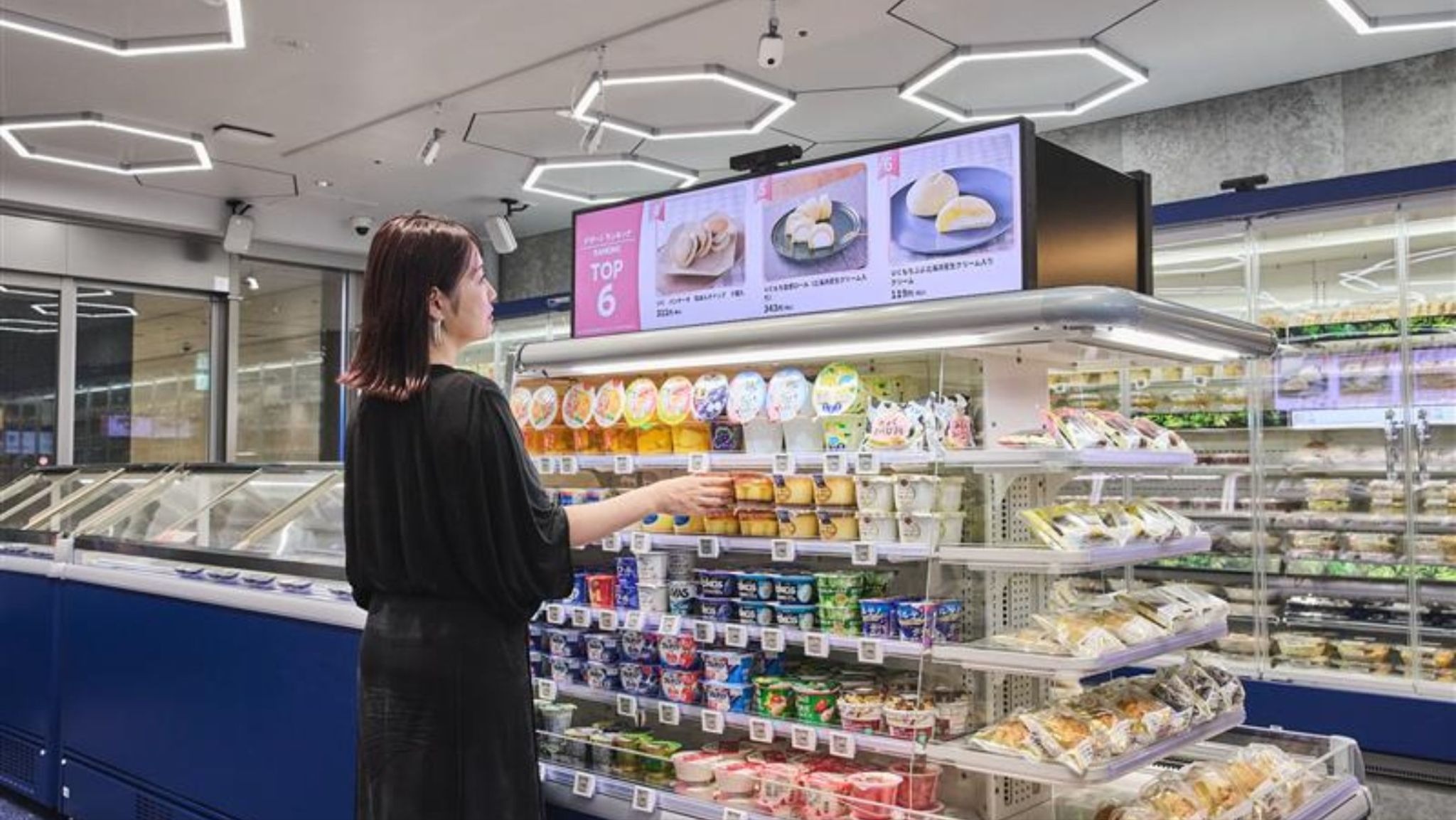
When you walk into a convenience store in Japan today, you may be encountering a technology that is quietly observing the flow of the store around you.
Near the entrance, beside product shelves, or next to the checkout counter, digital displays are doing far more than playing advertisements. These screens can analyze anonymous information such as estimated age groups, gender demographics, viewing patterns, and how long shoppers remain in front of a display. Based on those signals, they can instantly change what appears on screen.
This is the latest evolution of AI-powered digital signage, a technology that is gradually being introduced across parts of Japan's convenience store industry.
Traditional digital signage functioned much like an electronic version of a printed poster. Retailers scheduled advertisements based on the time of day, season, or promotional campaigns. While the content changed, it was generally the same for everyone who passed by.
AI signage fundamentally changes that model. Instead of broadcasting the same message to every shopper, it analyzes the environment in real time and adapts the displayed content accordingly. The retail space itself becomes responsive, transforming from a one-way advertising channel into an interactive media environment.
Japan's convenience stores, commonly known as konbini, provide an especially compelling testing ground for this technology.
Unlike many retail environments, convenience stores attract a remarkably diverse customer base throughout the day. Morning hours are dominated by commuters grabbing coffee and breakfast. Lunchtime brings students and office workers. Evenings see another wave of customers stopping by on their way home.
At the same time, visits are brief. Most customers spend only a few minutes inside the store. Few retail environments combine such high traffic, rapid turnover, and demographic diversity in such a compact space. For AI signage developers, it represents an ideal real-world laboratory.
Yet introducing technology that analyzes human behavior also requires caution. Concerns surrounding privacy and surveillance cannot be ignored, particularly in everyday public spaces. As a result, Japanese deployments have generally emphasized strict boundaries around data usage, including systems designed not to identify individuals and clear limitations on how information is processed.
This careful approach has led to a distinctly Japanese version of AI signage, one that balances technological innovation with social acceptance.
In this article, we'll explore how convenience store AI signage works, why it has gained attention in Japan, and what it may reveal about the future of retail itself.
Idein Overview
One company helping drive this shift is Idein, a Japanese technology firm specializing in edge AI solutions.
Its convenience store signage platform combines cameras with AI-powered analytics to optimize displayed content based on real-time customer behavior. The system can estimate broad demographic categories, measure dwell time, and evaluate visibility and engagement levels, allowing advertisements and product recommendations to change dynamically.
A key characteristic of the platform is its privacy-focused design. Rather than identifying individuals, the system processes anonymous behavioral data locally through edge AI technology. Data analysis occurs within the store environment itself, reducing reliance on cloud processing and limiting the handling of personally identifiable information.
This capability allows retailers to tailor promotions according to changing customer patterns throughout the day. In a retail format such as convenience stores, where product turnover is rapid and customer demographics constantly shift, data-driven optimization offers advantages that traditional merchandising methods often struggle to provide.
What Does AI Signage Actually See and Analyze?
Source: MUGENLABO Magazine Homepage
Everything begins with observation, but not in the way humans typically think about seeing.
When a person looks at a shopper, they notice clothing, facial expressions, and other visual impressions. AI systems work differently. They focus on measurable characteristics such as movement patterns, body positioning, gaze direction, and spatial relationships.
These data points are processed in real time to understand how people interact with the retail environment.
One of the most common functions is demographic estimation. AI models can estimate broad age groups and gender categories from video feeds. Importantly, the objective is not to identify specific individuals. The systems are generally designed to avoid storing facial images or determining who a person actually is.
Seeing Beyond the Surface
Instead, the goal is to identify trends. For example, the system may detect that a particular store receives more office workers during the morning rush, more students in the afternoon, and more working professionals later in the evening. The displayed content can then automatically adapt to match those audience shifts.
Behavioral analysis is equally important.
The system can measure whether someone simply walked past a screen or paused to look at it. It can estimate how long attention was directed toward a display and whether engagement increased after certain content was shown.
For retailers, this provides a level of visibility that traditional advertising rarely offered. Historically, it was difficult to know whether a customer actually noticed an advertisement. AI signage introduces measurable performance indicators that help retailers evaluate which messages attract attention and which do not.
How Sensors Understand Shoppers
Much of this is made possible through edge AI architecture.
Rather than transmitting large volumes of video data to remote cloud servers, processing takes place on devices located inside the store. Only the information necessary for analysis is utilized. This reduces latency while also supporting stronger privacy protections.
In Japan's highly visible and heavily trafficked convenience store environment, this privacy-conscious design has been a key requirement for adoption.
Ultimately, AI signage is not simply a tool for monitoring people. It functions more like a sensor that helps retailers understand the environment around it and respond accordingly. By analyzing behavior without focusing on individual identities, it maintains a balance that has helped make the technology more acceptable to both retailers and customers.
How AI Signage Is Creating a New Retail Experience
The introduction of AI signage is gradually changing the nature of the convenience store retail environment in Japan. Traditionally, store layouts were relatively static, built around product shelves, promotional displays, and printed advertisements. Decisions about which products to highlight or which marketing messages to feature often relied heavily on the experience and intuition of store operators. AI signage introduces a different approach by continuously updating those decisions based on real-time data and customer behavior.
One of the most visible changes is the ability to adapt messaging throughout the day. During the morning rush, customers tend to move quickly through stores and have little time to engage with lengthy content. As a result, concise, highly visible messaging becomes more effective. In the evening, however, shoppers often spend more time browsing and are more receptive to detailed information. AI signage can detect these shifts in customer behavior and adjust not only the content being displayed but also the pace and style of presentation. In effect, the store environment becomes responsive to the rhythm of the day.
The connection between information and purchasing decisions is also becoming more direct. When a promoted product appears on a screen positioned beside the shelf where that product is stocked, information and merchandise become physically linked. Customers no longer need to actively search for an item. Instead, they can move naturally from awareness to purchase the moment they notice something relevant. This is not an aggressive sales tactic. Rather, it is a subtle form of guidance that fits seamlessly into the shopping experience. The result is a smoother customer journey with less friction.
Creating a Store Environment That Adapts to You
AI signage also serves as a testing and optimization tool for retailers. Operators can measure how many people looked at a display, how long they paused, and whether engagement increased after specific content was introduced. These insights allow retailers to continuously refine their messaging. Instead of creating a display once and leaving it unchanged, stores can evolve through ongoing adjustments based on measurable customer responses.
None of these changes are particularly dramatic on their own. Yet the accumulation of countless small improvements can gradually reshape how a store feels and functions. AI signage represents another step in the evolution of the convenience store, one of Japan's most refined and efficient retail formats.
Why Has AI Signage Been Accepted in Japan?
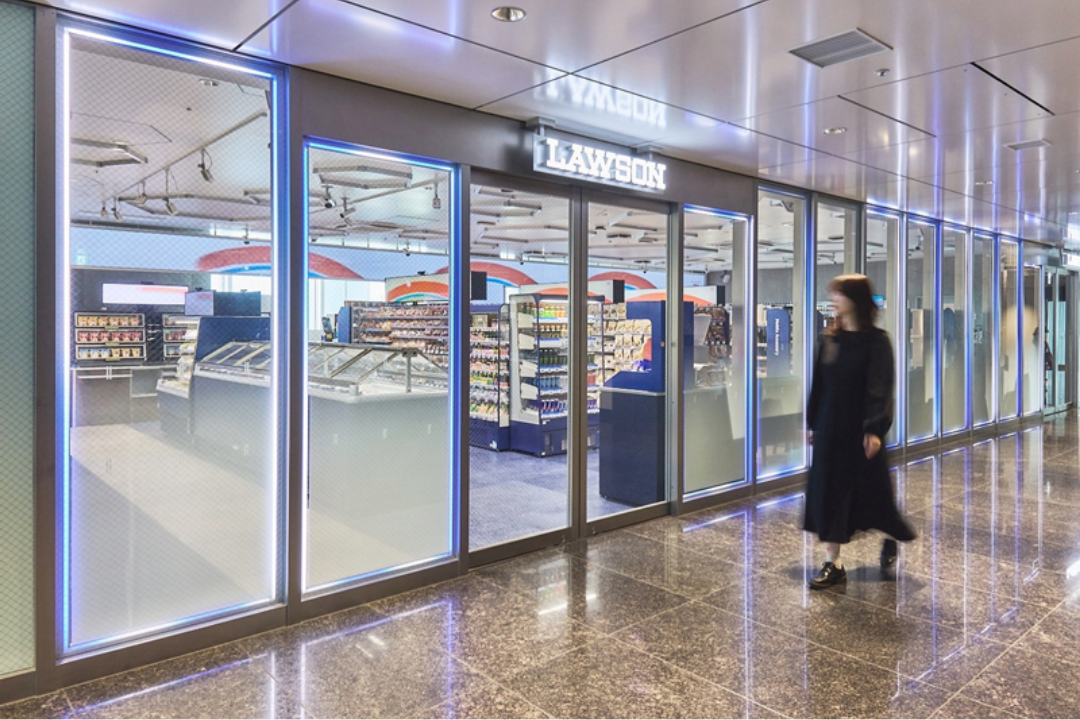
Source: MUGENLABO Magazine Homepage
The adoption of AI signage in Japanese convenience stores is not simply the result of technological advancement. It is equally the product of careful privacy-focused design.
Any technology that analyzes human behavior carries the risk of being perceived as surveillance if implemented poorly. This concern is particularly relevant in convenience stores, which serve as highly public and frequently visited spaces. Even the feeling of being analyzed without consent can create discomfort among customers. As a result, AI signage deployments in Japan have generally been built around a guiding principle: avoid going too far.
Why Digital Content Never Stays Static
One of the defining characteristics of these systems is their commitment to anonymity. While camera footage is temporarily processed for analysis, facial images are not typically stored, and the systems are not designed to identify specific individuals. Instead, they work with estimated demographic categories such as age group and gender, along with aggregate information such as visitor counts and dwell time. The goal is not to determine who entered the store, but to understand broader patterns, such as which customer groups are most common during specific hours of the day. This distinction significantly reduces concerns about privacy.
Edge AI technology plays an equally important role. Rather than transmitting video data to external cloud servers, analysis is performed locally within the store. This reduces both latency and the risk of sensitive information being exposed. More importantly, it reflects a broader social priority. In Japan, trust and peace of mind often carry as much weight as convenience. AI signage has gained acceptance in part because it is designed to coexist with those expectations.
Transparency is another key factor. Many stores clearly communicate that cameras and analytics systems are in operation. By informing customers about what data is being collected and how it is being used, retailers help reduce uncertainty and build trust. This openness has been essential in integrating AI technology into everyday retail environments.
Technically speaking, AI signage could be deployed almost anywhere in the world. What makes Japan notable is not simply the technology itself, but the way its use has been shaped by social expectations, cultural sensitivities, and privacy considerations. Japanese convenience stores have become a real-world example of how technological innovation and public acceptance can be balanced.
How AI Signage Is Changing Store Operations Behind the Scenes
The impact of AI signage extends far beyond what customers see on the sales floor. In many ways, the most significant changes are happening behind the scenes, within day-to-day store operations.
Convenience stores have long relied on sales figures and point-of-sale data to understand performance. However, one major blind spot remained: what actually happens in front of the shelves. AI signage helps fill that gap.
For example, when a promotional video is displayed, retailers can measure how many people looked at the screen, how long they stopped, and whether nearby product sales increased afterward. Traditionally, such observations were largely anecdotal. With AI signage, customer engagement becomes measurable. Store operators gain valuable insights into why certain products succeed and why others fail to attract attention.
The Subtle Transformation of Retail Culture
This shift is also influencing the role of store staff. Retail decisions no longer depend entirely on personal experience or intuition. Instead, employees can use data to identify opportunities for improvement. Areas that once relied heavily on the expertise of veteran workers can now benefit from shared metrics and clearer decision-making frameworks. AI signage is not replacing human judgment. It is enhancing it.
The technology also creates new possibilities at the chain level. Even stores operating under the same brand can have very different customer demographics depending on location. Data collected through AI signage helps reveal these differences, allowing headquarters and store managers to tailor strategies more effectively. As a result, the traditional gap between centralized planning and local store operations can begin to narrow.
Most customers will never notice these operational improvements directly. Yet over time, stores become more refined, less cluttered, and better able to present relevant information in the right place at the right moment. AI signage is not a flashy vision of the future. It is a practical tool for continuous improvement, quietly helping retailers evolve from the inside out.
What Makes Japan Different? Why Convenience Stores Have Become an AI Signage Testbed
AI signage is not unique to Japan. Retailers in North America, Europe, and across Asia have experimented with combining artificial intelligence and digital displays. However, many of these initiatives take place in environments where customers spend significant amounts of time, such as shopping malls, airports, and large-format retail stores.
Japanese convenience stores present the opposite scenario.
Visits are brief. Customer journeys are highly streamlined. Most shoppers arrive with a specific purpose and leave within minutes. The fact that AI signage can function effectively under these conditions is one of the defining characteristics of Japan's retail environment.
Why Local Processing is Key to Customer Trust
In many international retail settings, signage serves primarily as a branding or atmosphere-building tool. Success does not necessarily depend on capturing immediate attention. In Japanese convenience stores, however, a few seconds may be all a retailer has. Shoppers rarely stop unless something instantly captures their interest. AI signage has been developed and refined within these unusually demanding conditions.
Another advantage lies in the consistency of Japanese convenience store operations. Store layouts, product placement standards, and customer flows are often highly standardized. This makes it easier to test new technologies across multiple locations and compare results. Retailers can quickly identify what works, what doesn't, and why. The ability to run numerous small-scale experiments at high speed has turned Japan's convenience store network into an ideal proving ground for retail innovation.
Cultural factors also play a role. Expectations surrounding privacy, transparency, and accountability are particularly strong in Japan. New technologies must earn public trust before they can become part of everyday life. These constraints have encouraged developers to focus on practical value rather than excessive data collection. As a result, AI signage solutions developed in Japan may have an advantage when expanding internationally, as they are already designed with trust and usability in mind.
Japanese convenience stores are more than retail outlets. They are environments where high expectations and operational constraints drive innovation. AI signage is quickly becoming one of the most visible examples of that process.
The Beginning of a Silent Dialogue: What AI Signage Reveals About the Future of Japanese Retail

Source: MUGENLABO Magazine Homepage
AI signage in convenience stores is not a technology designed to showcase an extravagant vision of the future. It does not speak directly to customers or aggressively compete for their attention. Instead, it quietly observes its surroundings and presents information that fits the moment.
This approach aligns remarkably well with the role convenience stores play in Japanese daily life.
What AI signage delivers is not automation for its own sake, but adaptability. Retail spaces can gradually adjust to changes in customer demographics, behavior patterns, and time of day. These adjustments are often subtle, but they improve both the shopping experience and store operations. Rather than replacing human intuition, AI provides an additional layer of insight that supports better decisions.
Equally important is the emphasis on privacy-conscious design. The Japanese approach demonstrates that successful AI adoption is not only about what technology can do, but also about what it deliberately chooses not to do. Clear boundaries, transparency, and restraint help create trust. In this sense, AI signage offers a practical model for balancing innovation with public acceptance.
Convenience stores occupy a unique place in society because they are used by virtually everyone. Changes that take root in these everyday spaces often reflect broader shifts in how technology becomes integrated into daily life.
AI signage is already beginning to function as a silent participant in that process, interpreting customer behavior, adapting retail environments, and shaping experiences without drawing attention to itself. Its evolution may provide valuable insights into the future relationship between retail, artificial intelligence, and the people they serve.
Conclusion
AI signage is changing Japanese convenience stores in ways that many shoppers may never consciously notice. Rather than introducing dramatic new shopping experiences, it quietly helps stores understand how customers move, what captures their attention, and how information can be presented more effectively in the brief moments people spend inside.
What makes Japan's approach particularly noteworthy is that it treats technological capability and public trust as equally important. By relying on edge AI, anonymous data processing, and clear limits on personal identification, companies such as Idein are demonstrating that retail innovation does not have to come at the expense of privacy. The goal is not to know who a customer is, but to better understand how a retail space is being used.
As AI becomes increasingly embedded in everyday environments, convenience stores offer a glimpse into a broader shift. Retail spaces are evolving from static locations into responsive environments that can continuously learn and adapt. The technology itself may fade into the background, but its influence on store operations, merchandising, and customer experiences will continue to grow.
Ultimately, Japan's AI signage is about more than smarter advertising. It represents a new way of thinking about physical retail; one where stores quietly learn from the people who use them while respecting the boundaries that make those spaces feel trustworthy. In that sense, Japan's convenience stores are becoming more than places to shop. They are real-world laboratories for the future of AI-powered retail.
FAQ About Idein's AI Signage
1. What Is AI Signage?
AI signage is a digital signage system that combines cameras with AI-powered analytics to analyze factors such as visitors' estimated age group, gender, dwell time, and gaze direction in real time. Based on this information, it can display advertisements, promotions, or information that are most relevant to the audience at that moment.
2. Does AI Signage Collect Personal Information?
No. AI signage is not designed to identify individuals. Rather than storing facial images or personal information, it uses statistical data such as estimated age groups, gender, visitor counts, and dwell time to help improve store operations and customer engagement.
3. What Types Of Information Does AI Signage Analyze?
AI signage can analyze estimated age groups and gender, as well as how long people stop in front of the screen, the direction of their gaze, and the number of people passing by. This information is then used to optimize the content being displayed.
4. What Is Edge AI?
Edge AI is a technology that processes data locally on devices within the store rather than sending it to the cloud. This helps reduce latency and enables faster responses, while also making it easier to protect privacy by keeping data within the local system rather than transmitting it to external servers.
5. How Can AI Signage Change The Retail Environment?
Because content can be adjusted based on the time of day and customer demographics, AI signage makes it easier to present relevant products and information to shoppers. By analyzing customer responses to displayed content, retailers can also continuously improve store layouts and promotional strategies.
6. Why Is AI Signage Becoming More Common In Japanese Convenience Stores?
Japanese convenience stores attract frequent visitors and experience significant changes in customer demographics throughout the day, making them an ideal environment for testing and refining AI signage. Their standardized operations and strong focus on service quality have also supported wider adoption.
7. How Does AI Signage In Japan Differ From International Examples?
While AI signage is often used in large shopping centers, airports, and other locations where visitors spend longer periods of time, systems in Japan are frequently optimized for convenience stores, where visits tend to be brief. They also place a strong emphasis on privacy protection and designs that do not identify individual customers.
8. Does AI Signage Help With Store Operations?
Yes. AI signage can support store operations by analyzing metrics such as viewer counts, dwell time, and customer responses to products or advertisements. These insights help retailers improve merchandising and promotional activities based on data rather than intuition alone.
9. Is AI Signage Intended To Replace Store Staff?
No. AI signage is not intended to replace store employees. Instead, it helps visualize customer behavior and provides data that can support decisions related to product placement, promotions, and overall store management, allowing staff to operate more effectively.
10. What Value Does AI Signage Bring To Japanese Retail?
AI signage enables retailers to adapt the shopping environment more dynamically based on customer behavior and time of day, helping create a more personalized and convenient shopping experience. At the same time, it demonstrates how data can be used responsibly while maintaining a strong focus on privacy; an approach that reflects Japan's balance between innovation, convenience, and trust.