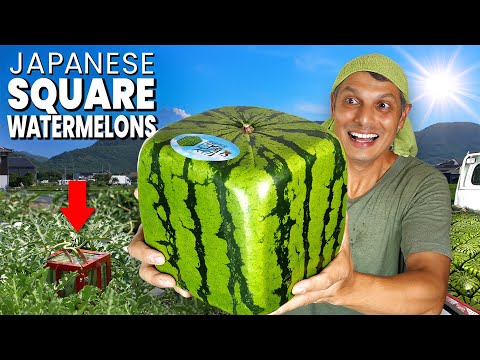
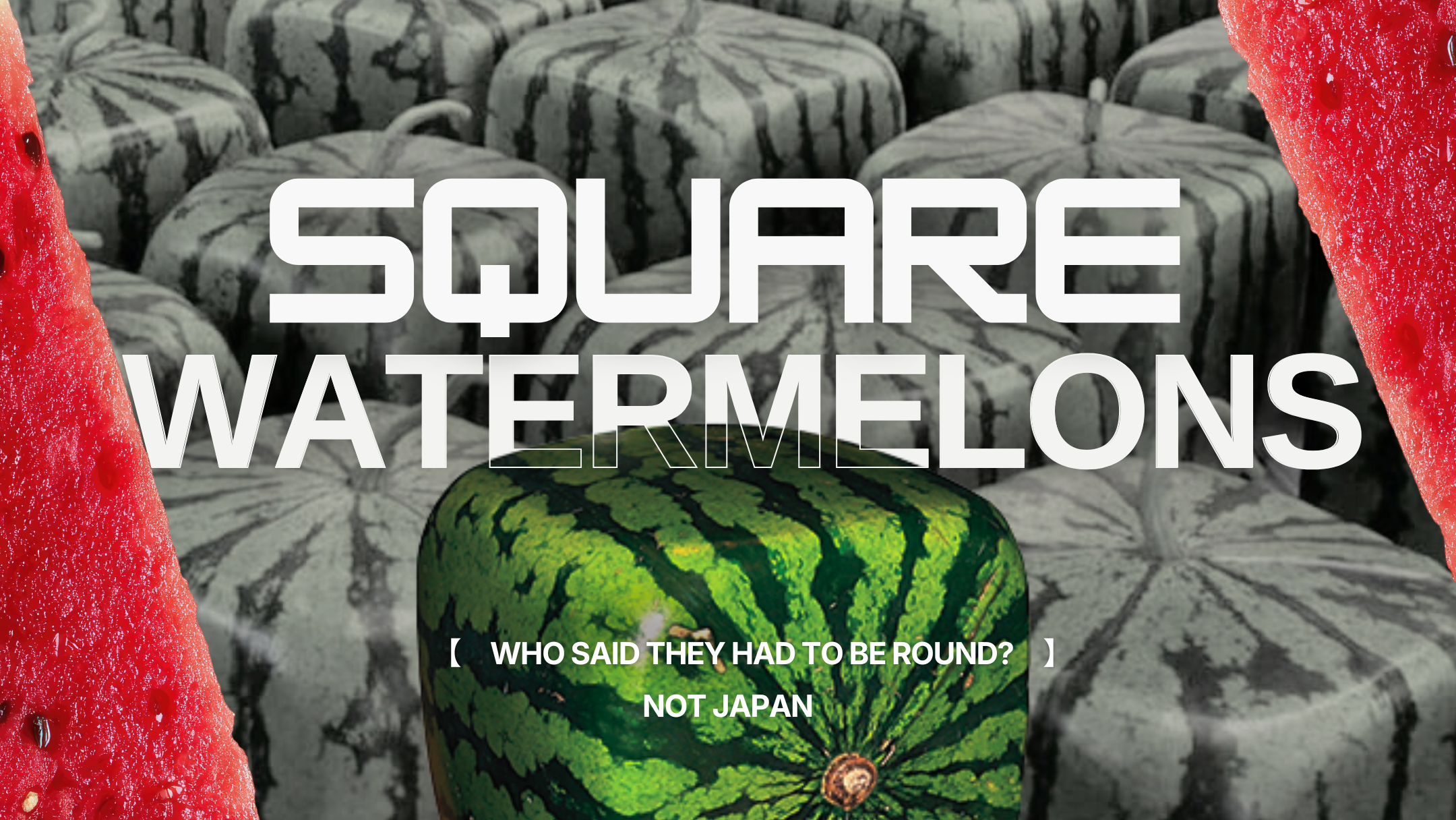
When we think of watermelons, round and striped ones usually come to mind. But in Japan, that image has been turned on its head with the invention of the square watermelon: a fruit grown into a perfectly boxy shape. Its visual impact has made it a standout in international media, where it is described as a uniquely Japanese creation.
In this social media era, a strong visual impact carries tremendous value. All it took was a single photo for the square watermelon to captivate viewers, making it a highly shareable and attention-grabbing item. It has become a hot topic among influencers and tourists both in Japan and abroad, standing out not only as a fruit but also as a unique conversation starter.
What’s surprising is that square watermelons weren’t originally meant to be eaten. These visually striking fruits were developed as ornamental watermelons, reflecting Japan’s clever agricultural techniques. The idea was to make a watermelon that fits more easily into refrigerators, serves as a striking gift, and showcases Japanese farming ingenuity. Today, these square fruits are cherished both in Japan and abroad as high-end novelty items and luxury gifts.
The concept first took shape through a farmer’s experiment in Kagawa Prefecture. By transforming an everyday crop into something unexpected, the farmer hoped to surprise and delight people. But the square watermelon went far beyond a novelty—it became a new kind of agricultural product with added value as a decorative object and gift. Over time, it gained recognition for its charm, craftsmanship, and cultural meaning.
The concept first came to life through an experimental effort by a farmer in Kagawa Prefecture. The idea was simple yet bold: transform a familiar crop into a shape no one had seen before. Behind it was the producer’s creative desire to deliver surprise and delight. It’s a powerful example of the craftsmanship mindset that Japanese farmers deeply value. The thought process behind questions like how to grow something that leaves a lasting impression or what kind of feeling a gift might inspire suggests a shift from farming as routine work to farming as a form of expression. This philosophy mirrors the spirit found in other areas of Japanese culture, such as traditional crafts and wagashi (Japanese sweets). More than just a novelty shape, the square watermelon gradually gained recognition as a product with added value—ideal for gifts and displays—and began to take root in the public consciousness.
This article takes a closer look at how square watermelons are grown, why they’re valued, and how they’ve captured the attention of people around the world.
Square Watermelon Overview
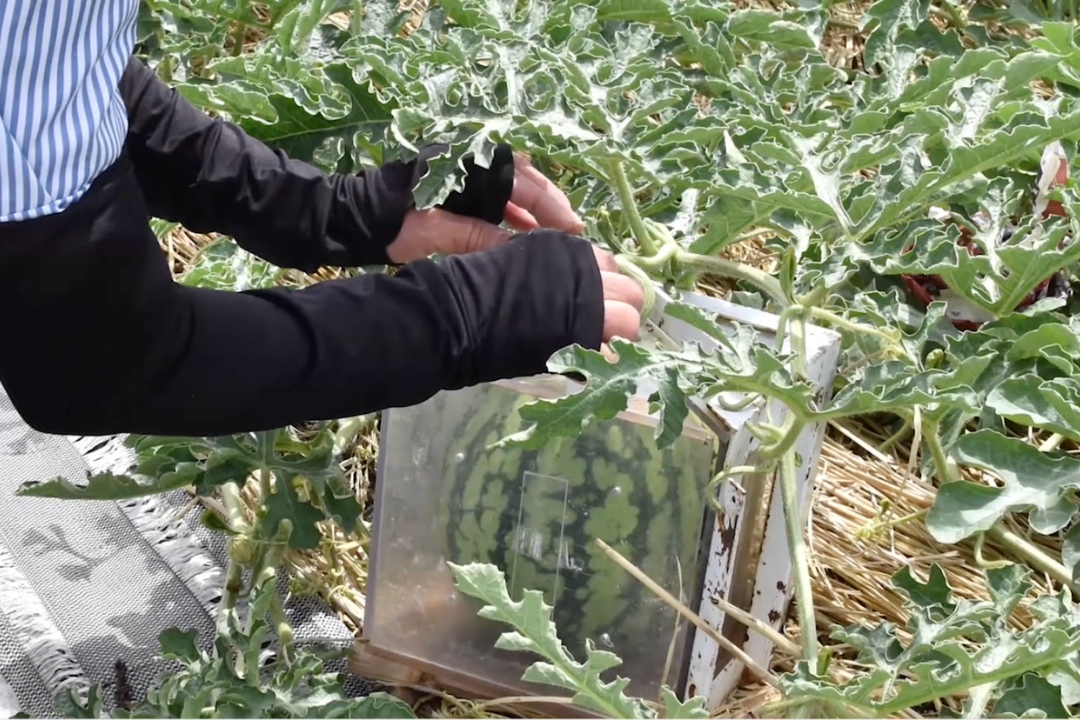
Square watermelons are ornamental fruits shaped by placing young watermelons into transparent acrylic boxes during early growth. The melons naturally expand to fill the box, taking on its square form. Known for their geometric beauty and symmetry, they are harvested before they ripen and are not intended for consumption. Instead, they are popular as luxury gifts, for display purposes, or as eye-catching attractions at tourist sites.
Square Watermelon: A Unique Specialty of Zentsuji City
The square watermelon is priced at 15,720 yen (tax included) and is used across a wide range of fields thanks to its strong visual impact and high level of originality.
In the fields of tourism and regional development, it serves as a symbolic product that clearly communicates local appeal, making it well suited for PR and branding initiatives. When shared with domestic and international visitors, it leaves a strong impression as a “one-of-a-kind” item and helps generate attention and buzz.
In the retail and gift industries, its non-edible, decorative nature allows it to be used as a display item that adds seasonal flair and visual impact, as well as a distinctive gift that feels special. It is also well suited for corporate commemorative items and exhibition displays, making it a valuable tool for enhancing spaces and strengthening brand value.
The Origin of the Square Watermelon
The square watermelon was created approximately 50 years ago. In the Hinooka area, where watermelon production was thriving, growers began searching for ways to add new value to watermelons, whose prices were prone to decline, and to sell them in a more appealing form. Through these efforts, the idea of the square watermelon was born.
The unique concept was inspired by the thought that a square shape, unlike a round one, might fit more easily into a refrigerator. Production began with this idea in mind, and the watermelon was initially considered for sale as an edible product. However, because it is grown inside a mold and harvested before fully ripening, it was found to lack sufficient sweetness and was not suitable for consumption.
As a result, the producers shifted their approach and began marketing it as a decorative watermelon—an unprecedented concept at the time. Its unusual appearance quickly attracted attention, and orders began to arrive from across Japan. Over time, the square watermelon became widely recognized as a local specialty of Zentsuji City and is now regarded as one of the region’s iconic products.
How Square Watermelons Are Grown
Source: JA Kagawa Homepage
Square watermelons are grown using a carefully controlled method. While the fruit is still small and tender, it is placed into a transparent acrylic case. As it grows, it conforms to the box’s shape. Throughout the growing process, farmers closely manage temperature, moisture, and sunlight to ensure the watermelon forms evenly and cleanly.
This shaping technique demands precise timing and expert technique. The fruit must be placed in the case at just the right moment, and even after that, the grower must continue to monitor the growth to avoid deformities. A slight misstep, whether it’s too early or too late, can result in a melon that fails to fill the case properly or develops an uneven shape. For that reason, only experienced farmers with years of know-how can successfully grow high-quality square watermelons.
Visual perfection is also a key requirement. The fruit must have a flawless rind with vibrant coloring and a consistent pattern. Farmers rotate the boxes regularly to ensure even exposure to sunlight and take care not to damage the skin. The work is more delicate and involved than ordinary watermelon farming.
The acrylic boxes themselves are custom-made. They are built with materials that balance breathability, durability, and light transmission, creating a microclimate suited to shaping the watermelon while maintaining its health. Since the cases are expensive, proper sanitization and reuse are also essential concerns in production.
Square watermelons are harvested earlier than edible ones—well before they ripen. This is because appearance is prioritized over sweetness or texture. In short, they are not grown for eating, but rather for display. As such, they are judged by their looks, not their flavor.
In this sense, the square watermelon isn’t just a fun idea, but rather a meticulously crafted agricultural object, one that reflects the precision and artistry of Japanese farming.
Pros and Cons of Square Watermelon
Source: JA Kagawa Homepage
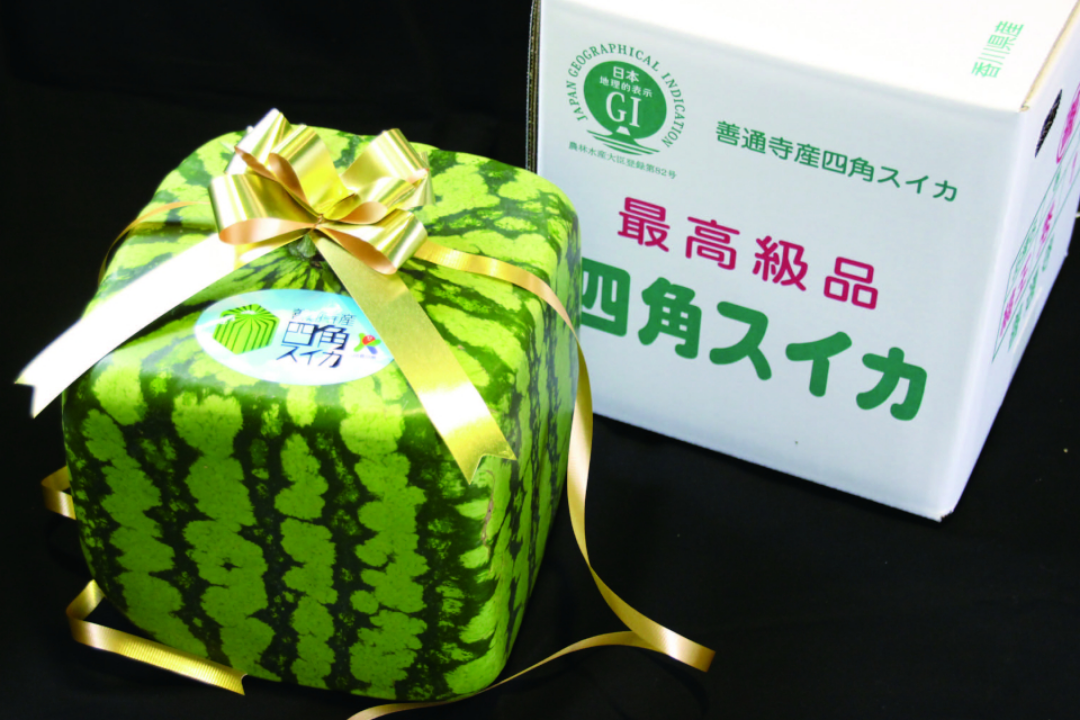
One of the most apparent advantages of square watermelons is their striking visual appeal. Their perfectly geometric form makes them ideal for memorable gifts and decorative displays, particularly in contexts where presentation and uniqueness matter. The boxy shape also provides a practical benefit: it offers greater stability during storage and transportation, reducing the risk of rolling or damage, something not possible with traditional round watermelons.
Beyond form and function, square watermelons embody Japan’s advanced agricultural techniques and meticulous attention to visual detail. They are often seen as a symbol of the country's farming innovation and are valued as carefully crafted, design-oriented agricultural products. This gives them cultural significance that extends far beyond their role as fruit.
However, there are clear challenges as well. Since square watermelons are harvested before they ripen, they are not suitable for consumption. This limits them to ornamental use, which may be less appealing to general consumers who expect fruit to be edible. Their high price also puts them out of reach for many. In addition, the production process is highly labor-intensive and requires specialized skills, resulting in very low output. This limited supply makes square watermelons hard to obtain and adds to their exclusivity.
Square watermelons are best appreciated not for practicality or taste, but for their cultural value and impact. They are a product that appeals to those who appreciate agricultural craftsmanship and visual storytelling.
Media and Social Media Buzz
Source: JA Kagawa Homepage
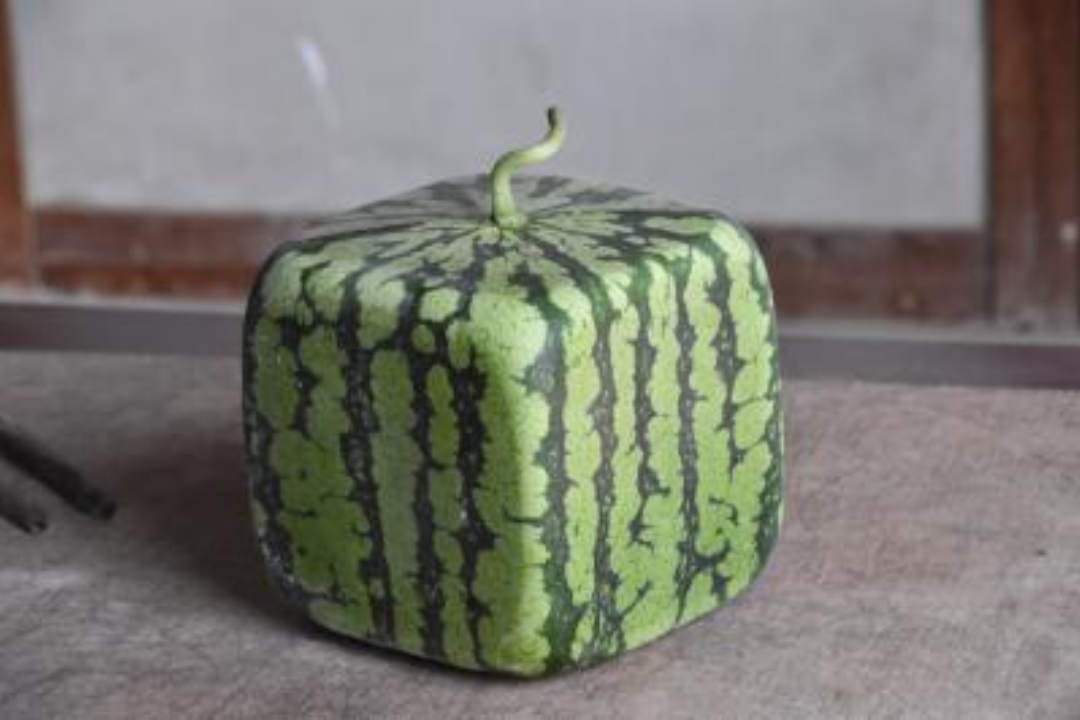
Because of their extraordinary appearance, square watermelons have gained widespread attention across media platforms. Japanese broadcaster NHK featured them on its program News Watch 9 in 2019, noting their practicality for refrigerator storage and popularity as gifts. They have also been featured on TV Asahi’s Morning Show and TBS’s N-st as a hallmark of the summer season.
Newspapers like Asahi Shimbun and Yomiuri Shimbun have covered them in regional editions, often as examples of how Kagawa Prefecture is promoting agricultural innovation. In financial and lifestyle magazines such as Nikkei Trendy, BRUTUS, and Casa BRUTUS, square watermelons are regularly introduced from the perspective of gift items and food as art, receiving praise for their unique design value.
On social media, hashtags like #squarewatermelon and #四角スイカ have taken off, especially on Instagram and TikTok. Many international users post reactions filled with surprise and admiration. On YouTube, international influencers who focus on Japanese culture often introduce square watermelons in their videos. One such video, by popular American creator Only in Japan, has been viewed over 300,000 times.
In Japan, the watermelons are increasingly used as photo-op installations at department store pop-ups and local specialty fairs. Their visual appeal has made them popular among younger audiences looking for “Instagrammable” experiences. As a result, square watermelons are becoming recognized not just as produce, but as a media-friendly cultural product.
Square Watermelons in Japan
Since ancient times, Japanese culture has assigned meaning to shapes. Squares and straight lines have symbolized order, harmony, and good fortune, appearing across architecture, crafts, calligraphy, and more. The square watermelon’s popularity as an auspicious gift reflects this cultural sensibility. The idea of infusing shapes with meaning is closely tied to Japan’s unique sense of aesthetics.
Most square watermelons are produced in Zentsuji, a city in Kagawa Prefecture, with JA Kagawa as a leading supplier. Only about 100 to 200 are produced annually, making them extremely rare. This scarcity contributes to their high price, typically between 10,000 and 20,000 yen. They are sold through high-end fruit shops, department store gift counters, and airport duty-free stores.
Demand peaks during Japan’s summer gift-giving season, when many stores sell them by reservation only. They’re considered a novelty fruit worth experiencing at least once. Beyond personal gifts, companies and luxury brands sometimes use them as premium giveaways or display pieces. Their uniqueness and craftsmanship make them especially appealing in the business gift market.
As ornamental items, they’re also popular for celebratory events like store openings, weddings, and anniversaries. Their unusual shape and auspicious symbolism make them an attractive choice for special occasions. Square watermelons resonate with Japan’s rich gift-giving culture and often take on greater meaning than regular produce.
They also appear at trade shows, gardening events, and regional tourism campaigns. Often positioned as icons of Japanese farming innovation, they serve as photo spots at events like Tokyo Dome’s "Furusato Festival" and regional food fairs. Their novelty makes them ideal for social media promotion as well.
Export and Global Interest
Thanks to their rarity and striking appearance, square watermelons have drawn attention internationally as well. They are especially popular among affluent consumers in parts of Asia, where they are viewed as exclusive, conversation-starting gifts. Export destinations include Hong Kong, Taiwan, Singapore, and the UAE.
In regions like the Middle East and Southeast Asia, Japanese agricultural products are strongly associated with quality and artistry. Within this context, the square watermelon is seen as a “status gift.” It has even been selected for occasions such as post-Ramadan celebrations and as a present for royalty. Its distinctiveness continues to gain recognition internationally, adapting gracefully to various cultural settings while maintaining its uniqueness.
Some foreign media have covered the fruit in terms of price—calling attention to square watermelons sold for several hundred dollars each—and often describe them as strange but fascinating examples of Japanese agriculture. In the West, they’re frequently featured in stories about Japan’s unusual and highly aesthetic approach to food.
Tourists often seek them out at exhibitions and airport stores, and they are increasingly viewed as a symbol of “Cool Japan”—a cultural export that reflects Japan’s creativity and innovation.
Conclusion
What once seemed like a farmer’s playful experiment is now a widely recognized symbol of Japanese creativity. The square watermelon reflects decades of agricultural trial and error, blending artistic vision with high-level farming skills to produce a fruit unlike any other.
In a country where gift-giving is a deeply rooted custom, the square watermelon’s unusual shape adds an extra layer of joy and meaning. As international tourism continues to rebound, it is likely to gain even more recognition as a designed agricultural product that represents modern Japan.
And looking ahead, its potential continues to grow: in educational settings, it is being introduced as a real-world example of combining agriculture with design. Some schools and programs are now incorporating hands-on activities where students grow square watermelons using special molds. These efforts spark creativity and help children discover the fun and wonder of farming.
The square watermelon is therefore likely to evolve beyond its role as a decorative item. It is increasingly viewed as a symbol of sustainable agriculture, regional branding, and the design potential of food culture. By sharing not just its eye-catching shape but also the story and thought behind it, the square watermelon is poised to become a “storytelling crop”—a cultural asset that communicates Japan’s creativity and appeal to the world.
Far from a mere gimmick, the square watermelon is the result of precision farming and artisan-level care. Beloved at home and admired abroad, it continues to draw attention not just for its looks, but for what it represents: the creative spirit and technical excellence of Japanese agriculture.
FAQ About Square Watermelons
1. What Makes Square Watermelons Different From Regular Watermelons?
The main differences are their shape and purpose. Square watermelons are grown for display rather than consumption. They are cultivated in acrylic molds to achieve their shape, with emphasis placed on visual appeal and novelty. Because they are harvested before fully ripening, they are not intended to be eaten like regular sweet watermelons.
2. How Are They Made Square?
When the fruit is still soft in its early growth stage, it is placed inside a specially designed acrylic box. As it grows, it takes on the shape of the container. This process requires precise control of temperature, water, and sunlight, making it a highly specialized cultivation technique.
3. Why Are Square Watermelons So Expensive?
The high price is mainly due to limited production and the level of skill required. Only about 100 to 200 are produced each year, and their cultivation demands careful management and specialized equipment. Their rarity contributes to prices typically ranging from 10,000 to 20,000 yen per fruit.
4. What Are They Commonly Used For?
They are mainly purchased as gifts or for display purposes. They are often chosen for occasions such as store openings, commemorative gifts, or corporate presents, where their visual impact and rarity add value.
5. Are There Any Common Regrets After Purchase?
A common issue is assuming they are edible. Square watermelons are intended for display and are not suitable for eating. It is important to understand their purpose before purchasing.
6. Why Are Square Watermelons Popular Overseas?
They are appreciated as a unique agricultural product that combines Japanese technology with aesthetic sensibility. In particular, they attract attention in high-end gift markets due to their rarity and novelty.
7. Where Can They Be Purchased?
They are sometimes available at department store gift sections, high-end fruit shops, and airport duty-free stores. Because quantities are limited, they are often sold through pre-orders or for a limited time.
8. Why Are Square Watermelons Considered Uniquely Japanese?
They reflect a cultural appreciation for form and beauty, combined with precise agricultural techniques. Rather than being just a fruit, they are cultivated as objects meant to be displayed, symbolizing a distinctly Japanese approach to craftsmanship and aesthetics.
Related Videos
If you're interested in Japan’s unique approach to agriculture and design, the video below introduces square watermelons, a creative twist on a traditional fruit. This video shows how farmers shape watermelons into cubes, combining practicality with eye-catching novelty.