
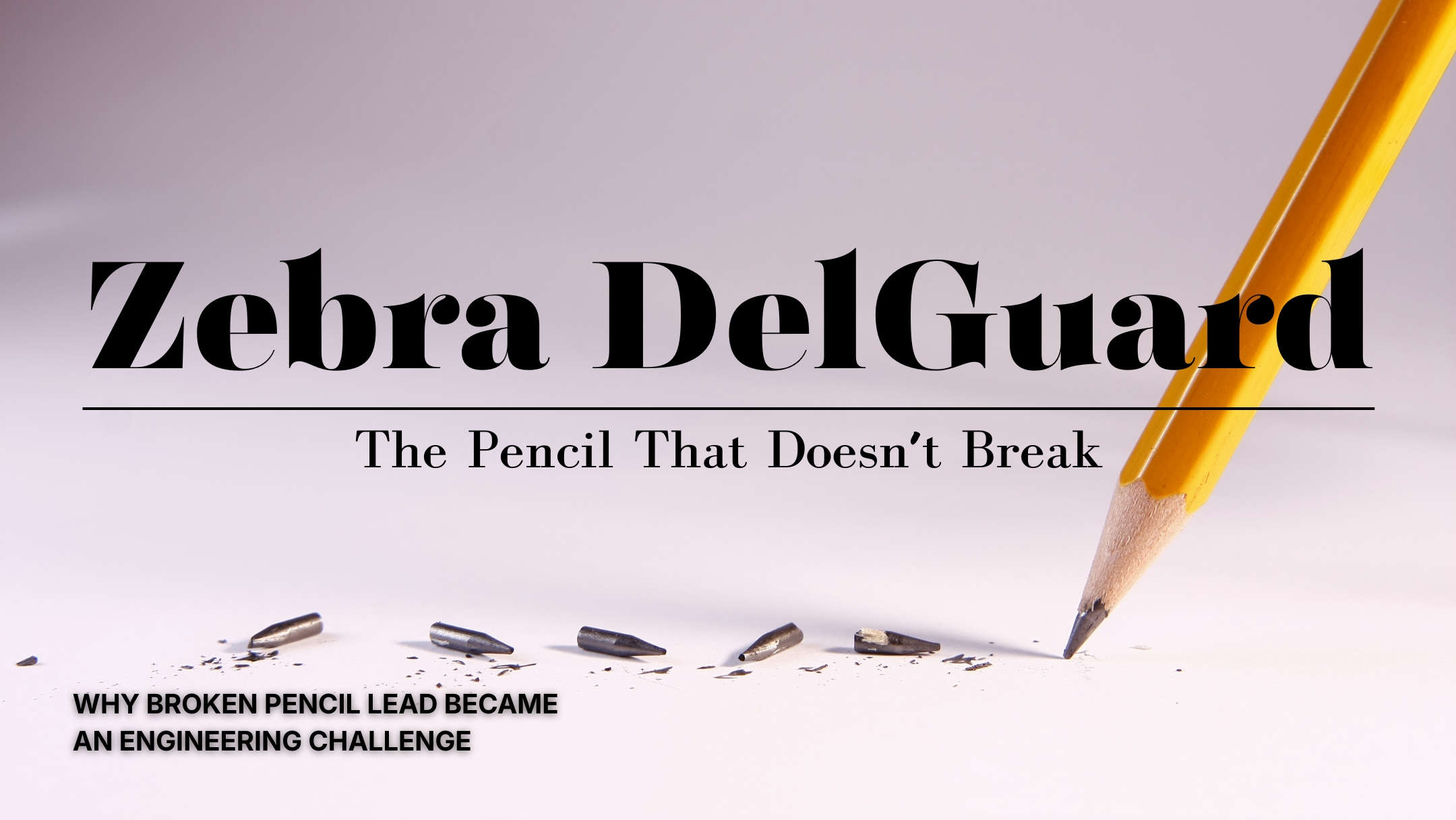
Pencils and mechanical pencils are everyday stationery items used by people around the world. Writing notes, drawing diagrams, solving equations; these are simple actions that are shared across cultures and countries. Yet the Japanese idea of creating a “mechanical pencil that never breaks” may seem a little unusual from an international perspective.
A broken lead is a small frustration that almost everyone who uses a mechanical pencil has experienced. Press too hard and the lead snaps. Hold the pencil at the wrong angle and it can break again. In many countries, this has simply been accepted as part of using a mechanical pencil. After all, the solution is easy: just extend more lead. It was rarely seen as a problem worth solving through technology.
In Japan, however, this small inconvenience gradually became something that could no longer be overlooked. A lead breaking in the middle of an exam, losing focus during class, or dealing with interruptions while doing detailed writing. These moments may seem minor, but they are familiar experiences for many people in Japan.
The reason behind this difference can be found in Japan’s education system and stationery culture. Students often spend long hours writing, exams require accuracy and speed, and writing small, precise characters is a common practice. Because of this environment, writing tools have been expected to do more than simply put ink or graphite on paper. They are expected to support concentration and allow ideas to flow without interruption. A broken mechanical pencil lead is not just a physical inconvenience. It can also interrupt a person’s train of thought.
With this background, Japanese stationery manufacturers began focusing on a seemingly simple goal: creating a mechanical pencil that would not break. The idea was not about making a product that looked impressive or adding unnecessary features. Instead, it was about creating a writing experience where users could continue writing smoothly without even thinking about the tool itself.
One of the best examples of this approach is the “unbreakable” mechanical pencil developed by a long-established Japanese stationery manufacturer. The product represents a unique Japanese style of craftsmanship: noticing small frustrations that people often cannot put into words and solving them quietly through careful engineering.
Why did this company become so determined to eliminate something as small as a broken pencil lead? And why did this idea come from Japan?
By exploring the company’s philosophy and the product that emerged from it, we can better understand the deeper meaning behind the “never-breaking” mechanical pencil and the values that shaped its creation.
DelGuard Overview
DelGuard is a mechanical pencil series developed by Zebra Co., Ltd., with its main feature being “lead that does not break.” It incorporates a unique mechanism that automatically distributes and absorbs the pressure applied to the lead while writing, allowing users to write with less risk of breakage even when pressing firmly or holding the pencil at an angle.
Priced within an accessible range for students, DelGuard has become one of Japan’s most popular mechanical pencils for studying and everyday writing. One of its greatest strengths is that it requires no special technique or adjustment. Users can simply write as they normally would and experience the benefit of the technology.
How DelGuard Protects Your Lead and Your Thoughts
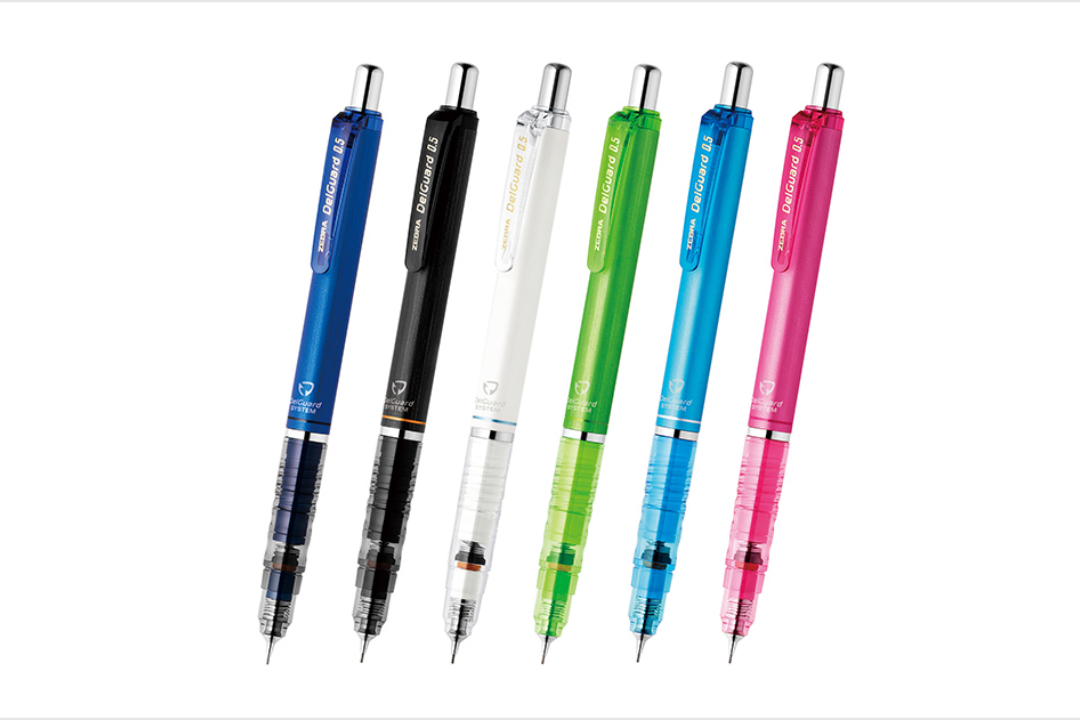
Source: ZEBRA Homepage
DelGuard was designed by first questioning the long-held assumption that “mechanical pencil lead is something that naturally breaks.” Traditional mechanical pencils have improved durability by making adjustments to lead thickness and material strength. DelGuard, however, took a different approach. Instead of simply making the lead itself stronger, it focused on controlling the force applied to the lead during writing, creating a system that naturally reduces the chance of breakage.
The purpose of this mechanical pencil is simple. Whether the user writes with heavy pressure or writes quickly, DelGuard allows them to continue writing without constantly worrying about broken lead. No special technique or settings are required. Users simply write as they normally would, and the internal mechanism automatically responds. The only thing the user needs to focus on is writing itself, while the problem of lead breakage is handled in the background.
Why the Mechanical Pencil is Still Evolving
Its usage is no different from that of an ordinary mechanical pencil. It is designed for everyday writing tasks such as taking notes, practicing exercises, answering exam questions, and drawing diagrams or graphs. Rather than being a specialized tool for professionals, DelGuard is designed to provide a stable writing experience across a wide range of everyday situations.
In Japan, DelGuard is positioned at a price point that makes it easy for students to purchase and use regularly. It is not a luxury stationery item meant to be collected or displayed. Instead, it is designed as a practical tool that is used every day, worn out through regular use, and replaced when needed. This pricing approach reflects the company’s goal of making DelGuard accessible to a broad audience rather than limiting it to stationery enthusiasts.
The main target users are students, as well as anyone who spends long periods writing. In learning environments, a broken lead can interrupt concentration every time it happens. DelGuard helps minimize these interruptions, allowing users to focus more fully on the act of writing itself. This benefit extends beyond studying, making it useful for business situations and everyday note-taking as well.
Stationery for the Modern World
DelGuard is not a product that tries to advertise its convenience through visible features. Instead, it is a tool designed to create a state where nothing goes wrong. Ideally, the fact that the lead does not break becomes so natural that users no longer even think about it. This design philosophy is what allows DelGuard to exist not merely as a mechanical pencil with added functionality, but as a tool that quietly supports the overall writing experience.
What Makes DelGuard’s Lead-Break Prevention System Different?
The uniqueness of DelGuard lies in the fact that it did not follow the traditional approach of simply “making the lead stronger.” With conventional mechanical pencils, manufacturers have mainly tried to improve durability by using harder materials or thicker lead. However, this approach has its limitations. Harder lead can affect writing comfort, while thicker lead can make it more difficult to write small, detailed characters. In some cases, improving durability could come at the expense of the overall writing experience.
The Secret Engineering Behind the World’s Toughest Pencil
Instead of focusing on the lead itself, Zebra focused on something different: how force is applied during writing. The main cause of lead breakage is not just pressure from directly above. In reality, the lead is also affected by sideways and diagonal forces caused by the writing angle and the movement of the hand. When these combined forces become concentrated in one area, the lead is more likely to snap. DelGuard was designed to reduce this concentration of force through its internal mechanism.
Inside the pencil, two protective systems work together. When writing pressure exceeds a certain level, one mechanism slightly retracts the lead, while another helps protect the lead when sideways pressure is applied. As a result, even when users press firmly or write at an angle, excessive stress is less likely to build up on the lead. The key point is that these adjustments happen automatically. Users do not need to think about the mechanism and can simply continue writing naturally.
This system is not designed to correct the user’s writing habits. Instead of asking people with heavy handwriting pressure to “learn to write more gently,” DelGuard accepts those natural habits and adapts to them. This reflects Zebra’s design philosophy: rather than changing the user, the tool itself should adapt to the user. This approach has long been seen in Japanese stationery design.
Why Only Japan Could Have Invented the DelGuard
From a cultural perspective, this approach can also be considered distinctly Japanese. In Japan’s learning environment, there are many situations where writing speed and accuracy are highly valued, leaving little time for students to consciously adjust their writing pressure or technique. DelGuard is designed to account for these unconscious movements and habits that naturally occur while writing.
The technological uniqueness of DelGuard does not come from a flashy feature that is immediately noticeable. Instead, it lies in creating a state where problems are less likely to happen. The goal is not simply to prevent the lead from breaking. The real value is that by preventing interruptions, users can maintain their concentration and continue writing smoothly.
This way of defining value is what sets DelGuard apart from other mechanical pencils. Its uniqueness lies not only in the technology itself, but in the philosophy behind it: creating a tool that quietly supports the user and improves the overall writing experience without demanding attention.
Why Did Zebra Create an “Unbreakable” Mechanical Pencil?
Source: ZEBRA Homepage
The development of DelGuard did not begin with the goal of creating a new market. Instead, it started by looking at a small inconvenience that had long been accepted as normal in Japan’s learning environments and everyday writing situations. A mechanical pencil lead breaking is something almost everyone has experienced, yet it was often dismissed as simply “part of using a mechanical pencil.”
One reason Zebra seriously addressed this issue was the company’s long involvement with writing tools used in educational settings. A student’s writing instrument is not just a tool for putting words on paper. It is used continuously during classes, homework, and exams. Small frustrations that occur during these moments can accumulate and eventually affect the overall learning experience.
A broken lead may only interrupt writing for a moment, but each time it happens, the user has to stop, extend a new lead, and regain their rhythm. These interruptions can reduce concentration and break the flow of thought. Zebra focused on this moment when concentration is lost and viewed lead breakage as not only a physical problem, but also a cognitive one.
How Zebra Solved a Problem Most People Ignored
During development, Zebra chose not to ask users to “write more carefully” or “use less pressure.” Writing pressure and writing habits vary from person to person, and changing those habits is not a realistic solution. Instead, the company concluded that the better approach was to create a tool that could provide a comfortable writing experience regardless of how someone naturally writes. This reflects Zebra’s strong focus on the user’s perspective.
The creation of DelGuard was not about showcasing advanced technology for its own sake. It was the result of trying to achieve a state where problems are solved before users even notice them. Preventing lead breakage is not the ultimate goal. It is simply a means of helping users maintain their concentration and continue writing without interruption. This philosophy extends from Zebra’s long-standing approach to creating stationery that supports users without getting in their way.
DelGuard demonstrates that the evolution of stationery does not always require dramatic change. Sometimes, innovation comes from carefully examining small frustrations and quietly solving them through technology. This ability to improve everyday experiences through thoughtful design is one of the strengths of Japanese stationery makers, and DelGuard stands as a representative example of that philosophy.
Where Does an Unbreakable Mechanical Pencil Make the Biggest Difference?
DelGuard is most widely used in educational settings. From elementary school students to high school students and those preparing for university entrance exams, many learners spend long hours taking notes and practicing problems. In these environments, even a small issue with a writing tool can have a significant impact on concentration. Every time the lead breaks, the user must stop writing, interrupting their train of thought and potentially reducing learning efficiency. By minimizing these interruptions, DelGuard helps create an environment where students can stay focused on their studies.
In classrooms, many students naturally write with strong pressure or at high speed. With traditional mechanical pencils, these writing habits often increased the chance of lead breakage. DelGuard, however, is designed around the user’s natural writing style rather than requiring them to change their habits. Instead of asking users to adjust the way they write, it supports them through the tool itself, reducing frustration from the early stages of learning.
This advantage is also valuable in business situations. During meetings or while recording ideas, people often need to write as quickly as they think. Even a brief interruption caused by a broken lead can disrupt the flow of ideas and cause important thoughts to be lost. DelGuard functions as a tool that allows users to continue writing smoothly without breaking their momentum.
The same applies to fields such as drafting, design, and research, where people often write detailed notes or draw precise lines for extended periods. When drawing at an angle, sideways pressure is easily applied to the lead, making breakage more likely with conventional mechanical pencils. DelGuard’s structure is designed to handle these types of forces, helping reduce interruptions and maintain consistent work efficiency.
Across these different applications, the value of DelGuard is not simply that the lead does not break. The greater value lies in the fact that writing, studying, and working can continue without interruption. By keeping the act of writing continuous, DelGuard helps preserve concentration and maintain the flow of thought. This benefit extends consistently across different industries and everyday situations.
The Behind-the-Scenes Work That Makes “Unbreakable” Feel Normal
The value of DelGuard lies not only in its unique mechanism, but also in the fact that it is consistently available as an everyday stationery item. A system that prevents lead breakage may be possible in prototypes or limited-edition products, but producing it continuously on a large scale at a price point suitable for students is far more challenging. Zebra has overcome this challenge through both its manufacturing systems and quality control processes.
At its core, DelGuard uses a precision structure with multiple moving components inside the mechanical pencil. Because the internal mechanism must respond instantly to changes in writing pressure and angle, even small variations in component accuracy or assembly can affect performance. For this reason, Zebra considers mass production from the earliest stages of design. Rather than simply increasing complexity, the company focuses on achieving the desired function with the minimum necessary movement, creating a structure that is both reliable and practical for large-scale production.
Engineering Stillness
Stability is also a major focus throughout the manufacturing process. Mechanical pencils are often treated as everyday tools. They are used repeatedly, dropped, and carried in pencil cases where they may be exposed to pressure from other items. To account for these conditions, durability tests are conducted to confirm that the internal mechanism continues to function properly over long periods of use. The standard for quality is not only that the lead does not break, but also that this performance can be maintained through everyday use.
Zebra’s quality control does not rely solely on inspecting finished products. Quality is maintained through multiple stages, including precision management of individual components, checks during assembly, and performance testing after completion. This reflects the company’s approach of applying strict industrial standards even to a product as familiar and simple as a writing instrument.
Material selection also requires careful consideration of the balance between writing comfort and durability. While DelGuard is designed to protect the lead, it is also engineered to avoid creating an overly rigid writing experience. The goal is not simply to make a product that is difficult to break, but to create a tool that people genuinely want to continue using.
Through the combination of careful manufacturing systems and detailed quality control, DelGuard has become more than a special-function product. It has established itself as a mechanical pencil that is easy to buy, easy to use, and reliable in everyday situations. The true strength of the product lies in making its advanced technology feel completely ordinary.
To Avoid Interrupting the Act of Writing as Much as Possible
At the foundation of Zebra’s product development is a consistent philosophy: do not force people to change the way they write. Rather than being the result of a single inventor’s idea, this approach can be seen as a long-term awareness of everyday challenges that has been built within the company since its founding.
Since establishing the company in 1897, Zebra has viewed writing instruments not simply as tools, but as essential products that support people’s thinking, learning, and work. Writing is closely connected to the process of thinking. If something interrupts that process, even if it seems minor, Zebra believes it is worth solving. This mindset has become a core principle behind the company’s approach to product development.
Protecting the Train of Thought
The value of being “unbreakable,” represented by DelGuard, comes from this same philosophy. A broken lead itself is not a serious problem. However, losing the flow of writing or having concentration interrupted can have a real impact on the quality of learning and work. Zebra did not overlook this effect. Instead, the company recognized that these frustrations are often difficult for users to put into words, which is why the tool itself should anticipate and solve them.
What is particularly important is that Zebra did not choose to solve the problem by correcting the user’s behavior. Rather than asking people with heavy writing pressure to use less force or change their writing style, the company focused on creating a tool that could provide a comfortable experience regardless of how it is used. This choice reflects an approach that accepts users as they are, rather than treating them as something that needs to be corrected or trained.
This philosophy has been especially strengthened through Zebra’s connection with educational environments. Students have different writing habits and styles, and it is not realistic to expect everyone to change in the same way. This is why tools that can be used comfortably by anyone are valuable. DelGuard is the result of translating this understanding of real-world situations into product design.
Zebra’s focus has never been simply about adding more convenient features. Instead, it is about removing unnecessary interruptions. The company aims to stay in the background of the writing process, supporting users without demanding attention. This quiet and thoughtful approach is a common thread across Zebra’s products, including DelGuard, and is one reason they have continued to be trusted for so many years
The Connection Between DelGuard, Local Culture, and Japan’s Writing Tradition
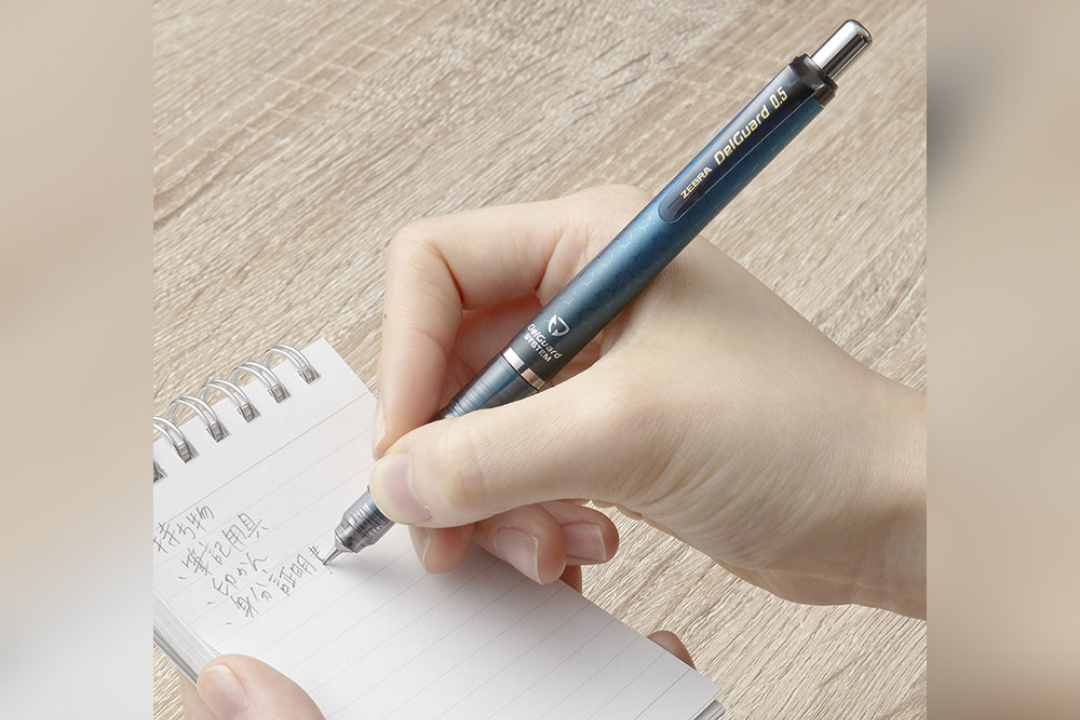
Source: ZEBRA Homepage
DelGuard is not a product directly connected to a specific regional resource or traditional craft. However, its development is deeply connected to Japan’s unique writing culture and educational environment. The reason Zebra found value in creating a mechanical pencil with “unbreakable” lead cannot be separated from the important role that writing has played in Japanese society.
In Japan, writing has long been regarded as a central part of learning and professional activities. In schools, students often spend significant time copying notes from the board, while exams require them to write accurately within strict time limits. In this environment, writing instruments are not merely tools for producing text. They function as essential support systems within the process of learning and evaluation. Even a small issue like a broken lead can become a factor that affects the overall writing experience when it happens repeatedly.
How a Pencil Eliminates Mental Interruption
Japan’s stationery culture also places value on the idea of creating tools that do not place unnecessary burdens on the user. A good tool should not demand attention or interfere with the user’s natural movements. DelGuard’s design philosophy reflects this mindset. The mechanism that prevents lead breakage works quietly in the background, without requiring users to adjust their habits or consciously think about how the product works. This subtle approach is a characteristic often associated with Japanese craftsmanship.
Based on this cultural background, Zebra has viewed writing instruments as everyday infrastructure that can be continuously improved. DelGuard is not a product that highlights a specific region or traditional technique, but it was created from the intersection of Japan’s educational environment and writing culture. In this sense, its origins and design philosophy are deeply rooted in a distinctly Japanese approach to creating tools that support daily life.
Expanding the Potential of the Unbreakable Mechanical Pencil
When considering the future of DelGuard, it is important to recognize that the product is not simply a one-time hit. Instead, it represents a broader direction in Zebra’s approach to developing writing instruments. The ability to prevent lead breakage is not the final goal, but rather the starting point for creating a more stable and comfortable writing experience.
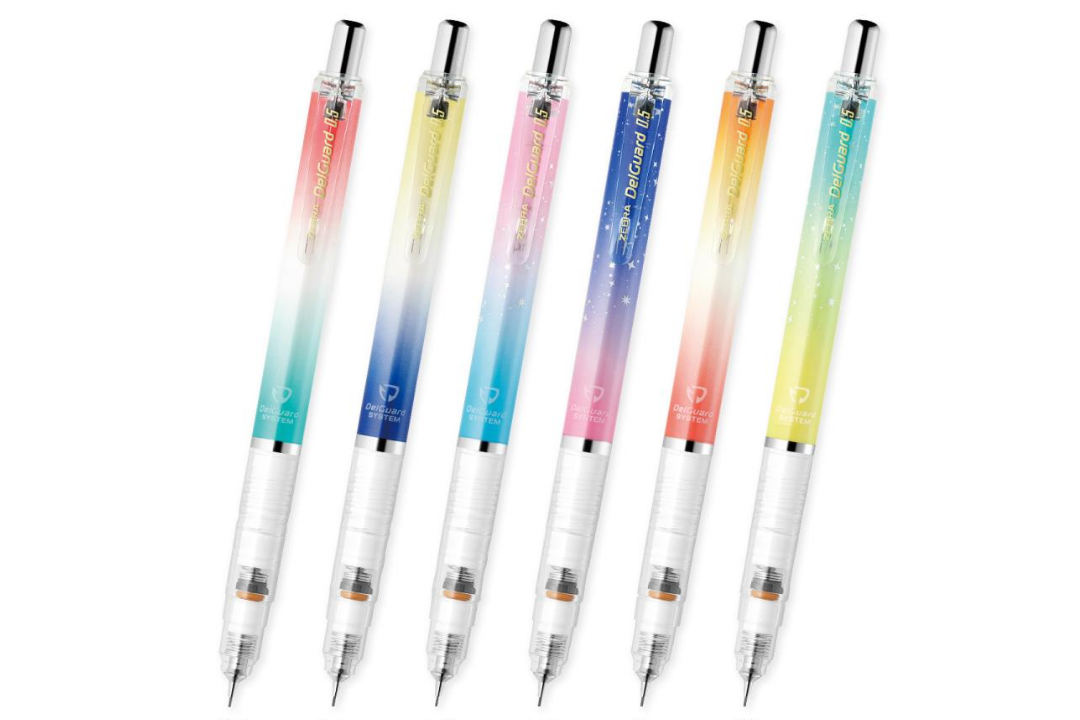
From a product development perspective, DelGuard has already evolved into a series with multiple variations. By adjusting factors such as barrel thickness, design, and grip materials, the product has expanded to meet the needs of different users, from students to everyday users and professionals. Moving forward, further improvements can be expected as Zebra continues refining the lead protection mechanism to better suit different purposes and user preferences.
However, Zebra’s goal is not simply to create more mechanical pencils that do not break. The more important idea is applying the same philosophy to other writing instruments: reducing the factors that interrupt the act of writing one by one. The concepts of controlling force and distributing pressure developed through DelGuard could influence future product development beyond mechanical pencils.
Why an Unbreakable Lead is a Competitive Advantage
From a brand perspective, DelGuard also plays an important symbolic role. The simple and easy-to-understand value of “unbreakable” lead allows even people who are not familiar with stationery to understand what makes the product unique. It represents Zebra’s broader philosophy: creating value not through a competition of flashy features, but by reducing the small frustrations users experience every day. This message is naturally communicated through the product itself.
Looking at international markets, DelGuard also has potential for gradual expansion. Even in countries where people may not write as extensively as in Japan, situations that require concentration and accuracy, such as education and specialized professions, exist around the world. Even in markets where lead breakage is not recognized as a major problem, the value of reducing unnecessary interruptions can be understood through actual use.
DelGuard’s design philosophy also aligns well with people who are interested in improving education quality and learning environments. By positioning it not merely as stationery, but as a tool that supports concentration, the product may find value in schools, educational institutions, and learning support settings. This creates a type of value that is less dependent on price competition.
For Zebra, DelGuard is not a finished answer, but rather a product that raises new questions. How much can a writing tool avoid interfering with the act of writing? How much unnecessary stress can be removed from everyday actions? The continued search for answers to these questions will likely influence the company’s future products.
The future of DelGuard is not only about expanding sales volume. Through one simple improvement, preventing lead breakage, Zebra aims to enhance the overall quality of the writing experience. This steady accumulation of small improvements represents the long-term direction behind the product.
What Happens When Lead Breakage Is No Longer a Problem?
A common theme among DelGuard users is that they do not simply praise the fact that “the lead does not break.” Instead, many people talk about the experience of being able to focus more fully on writing. In many reviews, users describe not an immediate sense of surprise when first using the product, but the gradual changes they notice after using it for a period of time.
Student users often mention that they no longer need to worry about lead breakage during classes or exam preparation. This is especially true for people who naturally write with heavy pressure or have a habit of writing quickly. With traditional mechanical pencils, these users often experienced frequent lead breakage. Once that frustration disappears, many describe the experience as “writing feels easier” or “I no longer have to stop halfway through.”
What is particularly interesting is that many users eventually stop consciously thinking about the fact that DelGuard is “unbreakable.” Even those who initially try it with some skepticism often find that, after a few days, the habit of being cautious about lead breakage simply disappears. There is no longer a need to adjust writing pressure or worry about the angle of the pencil. Writing naturally and continuously becomes the new normal. This shift is what best represents DelGuard’s true value as a product experience.
Among overseas users and visitors to Japan, DelGuard is often discussed within the broader appreciation of Japanese stationery. Japanese writing tools are frequently praised for being “carefully designed down to the smallest details” and for having differences that become clear only through actual use. DelGuard is viewed as another example of this approach. The fact that such detailed engineering was applied to such a small problem as lead breakage itself becomes part of what surprises users.
On social media, DelGuard is not necessarily the type of product that spreads through flashy visuals or dramatic demonstrations. However, comments such as “I cannot go back to a regular mechanical pencil” or “I realized I use this one all the time” continue to appear. This suggests that its appeal comes not from temporary attention, but from being genuinely valued in everyday use.
What emerges from user feedback is not simply the idea that DelGuard is “convenient.” Instead, it reduces the unconscious stress that comes with writing, helping users maintain concentration and work more consistently. Many users only fully recognize this improvement when they look back on their experience. This quiet sense of satisfaction is one of the reasons DelGuard has continued to be used over the long term.
How Widely Has the Unbreakable Mechanical Pencil Been Adopted?
In Japan, DelGuard is no longer seen as simply an unusual stationery product. It has become widely recognized as a standard choice among mechanical pencils for studying. This reputation was not built through a single moment of attention or a short-term marketing campaign, but through years of continued use and repeat purchases.
In terms of media exposure, DelGuard has been featured in newspapers, business publications, and education-related media. What attracted attention was not only the function itself, the fact that “the lead does not break,” but also the thinking behind its development. The product was recognized for addressing a small inconvenience that had long been accepted as normal within Japan’s learning environment and writing culture, turning it into a new source of value.
From a sales perspective, DelGuard has also maintained strong support over time. Although it offers advanced functionality for a student-focused stationery item, it remains within a price range that allows everyday purchase. This has helped it reach a wide range of users rather than being limited to a specific group. Many users continue using the same series as they progress through different school years or move into different writing situations, showing how deeply the product has become established.
The way it is positioned in retail stores is also significant. DelGuard is not displayed as a temporary trend item or a limited-time product. Instead, it is commonly placed in regular mechanical pencil sections for students. This shows that it is viewed not as a passing trend, but as one of the standard options available when choosing a writing tool. Stationery stores and retailers continue to carry multiple versions of the series consistently.
The accumulation of reviews and word-of-mouth feedback also represents part of DelGuard’s long-term success. Even years after its release, users continue sharing their experiences through social media and review platforms. Rather than becoming popular through a sudden burst of attention, the product has gained recognition through the quiet realization that it is simply better to use over time. This matches Zebra’s broader philosophy of creating products that provide lasting value.
The achievement of DelGuard in the Japanese market is not only that it became a successful product in terms of sales. Its greater accomplishment is that it helped make the idea of break-resistant writing feel ordinary. The ability to prevent lead breakage has moved beyond being a special feature and has become a natural reason for choosing the product. This position represents the level of acceptance DelGuard has achieved in Japan’s stationery market.
Is the Value of an “Unbreakable” Mechanical Pencil Uniquely Japanese?
While DelGuard was born out of Japan’s educational environment, the core value it offers is not limited to Japan. Mechanical pencil lead breaking is a universal experience. The difference lies in whether it is treated as something unavoidable or recognized as a problem worth solving.
In markets around the world, there are many situations where concentration and productivity matter. Students taking exams, researchers recording observations, engineers creating technical drawings, and designers sketching ideas all share a common need: the ability to keep writing without disrupting their train of thought. What DelGuard provides is not simply the result of lead that does not break, but a writing experience that is less likely to be interrupted. That value has relevance far beyond Japan.
From a cultural perspective, lead breakage may not be as visible a problem in countries where people spend less time writing by hand. However, that does not necessarily mean the problem does not exist. In many cases, it may simply not have been recognized as something worth addressing. DelGuard is the kind of product whose value becomes clear through use. Rather than solving a highly visible problem, it makes users realize how many interruptions they no longer experience.
When Japanese stationery is praised overseas, people often point to its attention to detail and its ability to adapt to the user rather than forcing the user to adapt to the product. DelGuard is a clear example of this philosophy. Instead of making the lead itself stronger, Zebra focused on controlling how force is applied to the lead. This reflects a design approach in which the tool adapts to the user, rather than expecting the user to change their behavior.
From a market perspective, DelGuard is particularly well suited to educational and professional environments. For people who care about learning efficiency, concentration, and productivity, the product offers a clear functional benefit relative to its price. Rather than positioning it as a premium stationery item, it can be understood as a practical tool that supports the quality of study and work. This gives it value that extends beyond simple price competition.
The appeal of DelGuard in international markets is not that it exports Japanese stationery culture unchanged. Its strength lies in presenting a universal idea in a tangible form: writing tools should interfere with the act of writing as little as possible. As education, work habits, and learning environments continue to evolve around the world, that philosophy has the potential to resonate far beyond the country where it originated.
What Its Limited Visibility Says About Its Position in Global Markets
There are relatively few widely publicized stories about DelGuard becoming a major overseas success or achieving explosive popularity in a particular country. This does not mean the product has not been sold internationally. Rather, it suggests that Zebra has not positioned DelGuard as the centerpiece of its global strategy or promoted it as a flagship symbol of international expansion.
In practice, Zebra has been supplying products to overseas markets for many years, particularly through categories such as ballpoint pens and markers. DelGuard has also been distributed internationally as part of the company’s broader product lineup. However, the kind of messaging seen in Japan, where the value of being “unbreakable” is clearly articulated and established as a defining feature, has been more limited outside the domestic market.
This does not necessarily mean DelGuard is less valuable or less appealing overseas. Instead, it may reflect the fact that in many markets, lead breakage has not yet been widely recognized as a problem that needs solving. In that sense, the challenge is not the product itself, but how its value is communicated. The benefit exists, but it has not always been translated into terms that resonate with local users.
DelGuard is also a product whose value becomes most apparent through actual use. Unlike products that can be understood immediately from a specification sheet or a short advertisement, its appeal is often discovered through experience. Users tend to appreciate it after they realize they are no longer dealing with interruptions they once accepted as normal.
For that reason, future international growth may require more than simply exporting the product. Demonstrations, hands-on experiences, educational partnerships, and other opportunities that allow people to experience the benefit firsthand may be more effective than traditional feature-based marketing. DelGuard is the kind of product that reveals its value gradually, making it particularly well suited to an approach that emphasizes user experience rather than product specifications alone.
Why Should Global Companies Pay Attention to an “Unbreakable” Mechanical Pencil Today?
DelGuard is not a product that attracts attention through bold design or flashy features. Its value comes from something much quieter: maintaining a state in which nothing goes wrong while people are writing. The goal is not simply to prevent lead breakage. The real benefit is allowing users to continue writing without interruption, helping them maintain concentration and stay in the flow of their thoughts.
This idea emerged from Japan’s writing culture and educational environment, and reflects a challenge that Zebra has been addressing for decades. Rather than asking users to change their behavior, the company chose to create a tool that adapts to the user. This philosophy extends beyond a single mechanical pencil and represents a broader characteristic of Japanese product design: reducing friction in everyday activities through thoughtful engineering.
Why Concentration is the Real Goal of Japanese Stationery
For overseas companies, the key is to view DelGuard as more than just a stationery product. Its value is connected to universal themes such as learning efficiency, concentration, productivity, and workflow continuity. Whether in education, professional environments, research, design, or any situation that involves extended periods of writing, the product addresses a challenge that is relevant across industries and cultures.
DelGuard also benefits from being highly accessible. It is not a premium luxury item that requires extensive explanation or specialized knowledge. Instead, it is an experience-driven product whose advantages become clear through everyday use. This makes it well suited to international distribution, educational partnerships, workplace initiatives, and other contexts where users can experience the benefits firsthand.
More broadly, DelGuard represents a mindset: the belief that small frustrations should not simply be accepted because they seem minor. By identifying an everyday inconvenience and addressing it through design, Zebra transformed something people rarely questioned into a better experience. This approach has long been one of the strengths of Japanese stationery manufacturers.
As organizations around the world place increasing emphasis on learning outcomes, productivity, and user experience, the ideas behind DelGuard become increasingly relevant. The product itself may be simple, but the principle it embodies, reducing unnecessary interruptions so people can focus on what matters, has the potential to create value far beyond the stationery industry.
Conclusion
DelGuard proves that even the smallest frustrations are worth solving. A broken pencil lead may seem insignificant, but repeated interruptions can disrupt concentration, slow down learning, and break the flow of ideas.
What makes DelGuard stand out is not the technology itself, but the thinking behind it. Rather than asking people to change the way they write, Zebra created a tool that adapts to the user and quietly removes a common source of stress. The result is a writing experience that feels smoother, more natural, and less distracting.
In many ways, DelGuard reflects the best of Japanese stationery design: careful attention to everyday problems and a focus on improving the user experience without drawing attention to itself. Its success shows that innovation does not always have to be dramatic. Sometimes, the most valuable products are the ones that simply help people focus on what they are trying to do.
FAQ About DelGuard
1. What Is DelGuard?
DelGuard is a mechanical pencil series developed by Zebra Co., Ltd. that is designed to prevent lead breakage. Its internal mechanism adjusts to the pressure applied while writing, helping protect the lead even when users write forcefully or apply pressure at an angle. One of its key features is that it works automatically, allowing users to write naturally without changing their writing style.
2. How Is It Different From a Standard Mechanical Pencil?
The main difference lies in its approach to preventing lead breakage. Traditional solutions often focus on making the lead itself stronger or harder. DelGuard, however, protects the lead by controlling and absorbing the forces applied during writing. This allows users to continue writing as they normally would without having to adjust their habits.
3. Why Was So Much Attention Given to Preventing Lead Breakage?
Even though a broken lead may seem like a minor inconvenience, it interrupts the flow of writing. Whether studying or working, users must stop, extend the lead, and resume their task. DelGuard was developed to reduce these small but frequent interruptions, helping people stay focused on thinking, learning, and writing.
4. Who Is DelGuard Designed For?
DelGuard is particularly useful for students, professionals, and anyone who writes for extended periods of time. It is also well suited for people who write quickly or apply strong writing pressure. Rather than forcing users to change how they write, DelGuard adapts to individual writing habits and provides a more stable writing experience.
5. What Is Unique About DelGuard's Technology?
Its technology is designed to respond to pressure from multiple directions during writing. Whether strong downward force is applied or pressure comes from an angled position, the internal mechanism adjusts accordingly to protect the lead. Because these adjustments happen automatically, users can enjoy a natural and uninterrupted writing experience.
6. Why Are Japanese Stationery Products Highly Regarded Internationally?
Japanese stationery is often praised for addressing not only major functionality, but also the small frustrations users encounter every day. DelGuard is a good example. Rather than accepting lead breakage as unavoidable, it tackles a common annoyance through thoughtful engineering. This attention to user experience is one of the defining characteristics of Japanese stationery design.
7. How Does DelGuard Benefit Learning Environments?
By reducing interruptions caused by broken lead, DelGuard helps create an environment where users can maintain focus more easily. In classrooms and study sessions, the primary goal is to understand concepts and think critically. By minimizing disruptions from writing tools, DelGuard allows students to concentrate more fully on the learning process itself.
8. What Makes DelGuard Appealing to International Users?
Its appeal lies in solving a small but universal problem through innovative design. Lead breakage is something mechanical pencil users around the world experience, yet DelGuard approaches the issue by rethinking the mechanism rather than simply improving the lead. It demonstrates how stationery can be more than a disposable tool and instead contribute to concentration and productivity.
9. Why Has DelGuard Remained Popular Over Time?
One reason is that it requires no special learning curve. Users experience the benefits naturally without needing to change how they write. At first, they may notice how rarely the lead breaks. Over time, that reliability simply becomes part of the writing experience. Its ability to fit seamlessly into everyday use has contributed to its long-term popularity.
10. What Is the Greatest Advantage of DelGuard?
The greatest advantage is that it allows people to focus on their work rather than their writing instrument. Instead of adding flashy features, DelGuard improves the writing experience by removing a common source of interruption. Its value lies in supporting the simple act of writing from behind the scenes, helping users stay focused on what truly matters.
Related Videos
If you're interested in Japanese product design and engineering, the video below explores why Zebra developed an unbreakable mechanical pencil built for durability and everyday reliability. This video highlights the innovation and problem-solving that turned a common stationery item into a unique engineering achievement.